
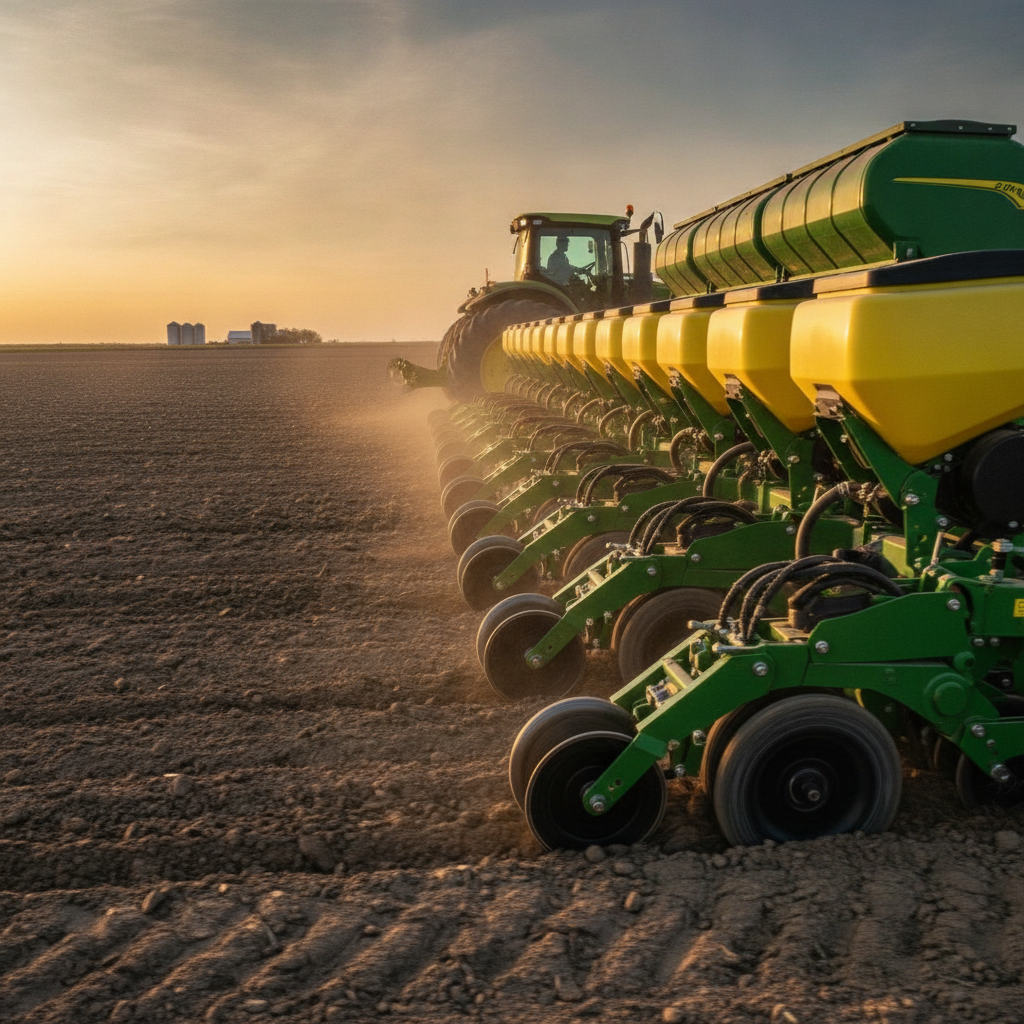
How Do Row-Crop Farmers Near Aberdeen Know Whether Their Steel Ring Is Actually Designed to Handle High-Speed Planting Passes — Or Just Rated for Slower Ground Speeds?
If you’re planting corn or soybeans near Aberdeen and you’ve upgraded to high-speed planting — whether that’s a newer-generation planter designed for 7–8 mph or an air seeder running wide-open across Brown County flats — your steel ring is under a different class of stress than the specs on most competitor product pages ever acknowledge. The short answer: most steel rings are not rated by speed at all, and the ones that weren’t engineered with high-speed operation in mind tend to show it in accelerated tire lip wear, loosening fasteners, or mud that packs faster than the scraper can clear it. Here’s what to actually look at before planting season kicks off.
Why Ground Speed Changes the Equation for Steel Rings
At 4.5 mph, a gauge wheel is spinning at a relatively modest RPM and the forces on the tire lip and ring mounting are manageable even with a mediocre fit. Bump that up to 7 or 8 mph — which is increasingly common on high-speed planters and larger air seeders running across the Northern Plains — and you’re looking at meaningfully higher centrifugal stress on the ring itself, more aggressive soil contact on each revolution, and a mud-shedding demand that nearly doubles in intensity.
The tire lip takes the worst of it. At higher speeds, the lip edge contacts abrasive soil more frequently per minute, and if there’s no protective ring riding that surface, you’ll wear through a gauge wheel tire faster than you would have predicted based on your old 4.5 mph pace. That’s not a hypothetical — farmers across South Dakota and into Minnesota who have made the jump to high-speed planting often report needing replacement tires sooner than they expected after the transition, particularly in the heavier gumbo clay soils that show up across parts of Brown County.
What Most Competitor Specs Don’t Tell You About Speed
Here’s a content gap worth noting: if you go to the product pages for steel rings on competitor sites, you’ll find plenty of information about material construction, diameter compatibility, and mounting hardware — but almost nothing about ground speed ratings or how the ring and its fastener system perform under the vibration and stress load of high-speed planting. That’s a real gap in the available information, and it matters when you’re trying to make a buying decision for a high-speed setup.
What you actually want to know is whether the ring stays seated and secure at 7–8 mph over uneven ground, whether the scraper function holds up at higher rotational speeds without deflecting or packing mud behind it, and whether the six-screw mounting system — the kind used on Jung Enterprise’s patented Steel Ring — is tight enough to resist the additional vibration load that high-speed planting generates. A ring that works fine at a slow walking pace and starts walking loose by the second field at speed is a problem you don’t want to diagnose mid-planting window.
The Scraper Function Matters More at Speed, Not Less
One of the features that gets overlooked in the speed conversation is the built-in scraper function. On a steel ring designed properly — like the one Jung Enterprise manufactures out of Ipswich — the ring doesn’t just protect the tire lip. It acts as an integrated scraper, preventing mud from packing between the tire and the gauge wheel hub as it rotates. At low speeds, this is useful. At high speeds, it’s critical.
When you’re moving fast through heavier soils, mud has less time to shed on its own between revolutions. If your ring doesn’t actively scrape, you end up with packed buildup that throws off gauge wheel balance, changes effective diameter, and starts affecting seed depth consistency. Farmers near Aberdeen and across the Northern Plains who are running high-acre spring runs on tight planting windows can’t afford to stop and manually clean packed gauge wheels mid-field. A steel ring that does its own scraping eliminates that stop.
The Jung Enterprise Steel Ring is engineered with this dual function from the ground up — tire lip protection and scraper action in a single part, mounted with six screws, and covered under US patent 11,707,013 B2. You don’t need a separate scraper add-on, which also means one fewer part to loosen, lose, or replace.
Durability Numbers That Are Relevant to High-Speed Operations
Field-tested results matter more than spec sheets when you’re talking about high-stress applications. The Jung Enterprise Steel Ring has been run across 13,000 planted acres over three years, showing only 1/16″ of wear over that span. That’s the kind of durability number that holds up whether you’re doing 4.5 mph or pushing the planter harder across flat Brown County ground. If a ring is engineered tight enough to survive 13,000 acres at real-world conditions, you can reasonably expect it to hold up when you’re chasing a narrow planting window at higher speed.
Compare that to OEM gauge wheel tires that can show visible tire lip wear inside a single season under high-speed conditions without any lip protection — and the math on whether a steel ring pays for itself becomes straightforward, especially for operations with higher per-season acreage.
Mounting Integrity Under High-Speed Vibration
Six screws sounds simple, but the way a ring seats against the tire bead and distributes clamping load around the lip matters a lot at higher speeds. A ring that’s slightly out of round or that relies on friction alone to stay in place is going to be a problem. The six-screw system on the Jung Enterprise Steel Ring distributes load evenly and installs cleanly without special tooling — which also means field installation or mid-season adjustment near Aberdeen or out in a field north of Ipswich doesn’t require a shop visit to get right.
If you’re buying for a fleet of row units on a 24-row or larger planter, that installation consistency across all rows matters. One row unit running a slightly loose steel ring at speed throws off depth uniformity for that row across the entire season.
Frequently Asked Questions
Does the Jung Enterprise Steel Ring work on high-speed planter models?
Yes. The Steel Ring is compatible across multiple OEM gauge wheel sizes and is field-tested under real working conditions that include hard planting pushes. The six-screw mount and integrated scraper design hold up at higher speeds where looser or friction-fit designs tend to fail or require more maintenance.
How fast does tire lip wear accelerate when you move from 4.5 mph to 7+ mph without a steel ring?
There’s no universal number because soil type plays a big role, but farmers in heavier gumbo clay soils — common across parts of Brown County and south into central South Dakota — consistently report faster tire lip wear at high-speed planting than they saw with the same equipment at conventional speeds. A steel ring effectively stops that wear category regardless of ground speed.
Do I need a separate scraper if I’m running a Jung Enterprise Steel Ring at high speed?
No. The built-in scraper function is part of the ring design. You don’t need a separate scraper component, which also reduces the number of parts that can vibrate loose during a high-speed run.
Will the six-screw mount stay tight at 7–8 mph over uneven ground?
The six-screw system is designed to distribute clamping load evenly around the tire lip. Standard field maintenance — checking fasteners before the season and after the first few hundred acres — is still good practice at any speed. But the mount is designed for field conditions, not just ideal surfaces.
Can I get Steel Rings for an air seeder running near Aberdeen, or just for row-crop planters?
The Steel Ring fits planters, air seeders, and no-till drills. If you’re running an air seeder on wheat ground near Aberdeen or across North Dakota, the same tire lip protection and scraper function apply — ground speed considerations are actually more acute on larger air seeders covering ground fast.
Talk to Jung Enterprise Before Your Next Planting Push
If you’re running high-speed planting equipment near Aberdeen, across Brown County, or anywhere in South Dakota and into Minnesota or North Dakota, it’s worth having a direct conversation about whether your current gauge wheel setup — including your steel rings — is actually engineered for the speeds and soil conditions you’re dealing with. Jung Enterprise is a family-owned American manufacturer based in Ipswich with real field-tested results behind every product we sell.
Take a look at our full product line, or reach out directly with questions about your specific planter or air seeder setup. We’ll give you a straight answer about what fits and what will hold up. Contact Jung Enterprise here — no runaround, no pressure, just honest answers from people who know planting equipment.