
How Do Steel Rings Hold Up in Heavy Clay Soils Near Mitchell? What South Dakota Farmers Should Know Before Buying
If you’re farming in the heavy clay and gumbo soils common around Mitchell, South Dakota, you already know those conditions are a different animal than sandy or loam ground. They cling to everything, they pack into every open space on your planter, and they wear equipment faster than the catalogs ever warn you about. So when someone sells you a steel ring as a fix for gauge wheel tire lip wear and mud plugging, the first fair question is: does it actually hold up when the ground is fighting back the hardest? The short answer from Jung Enterprise, based in Ipswich, is yes — but here’s what the numbers actually show, and what to watch for when you’re comparing options.
- What Clay and Gumbo Soils Actually Do to Your Gauge Wheel Tires
- What the Steel Ring Actually Does — and Why Clay Conditions Make the Built-In Scraper Matter
- Thirteen Thousand Acres and 1/16 of an Inch — What Field Testing Actually Shows
- What Competitors Don't Tell You About Soil-Specific Performance
- Compatibility: Does It Fit Your Planter?
- Frequently Asked Questions — Steel Rings in Heavy Soil Conditions
- Ready to Stop Replacing Tires Every Season?
What Clay and Gumbo Soils Actually Do to Your Gauge Wheel Tires
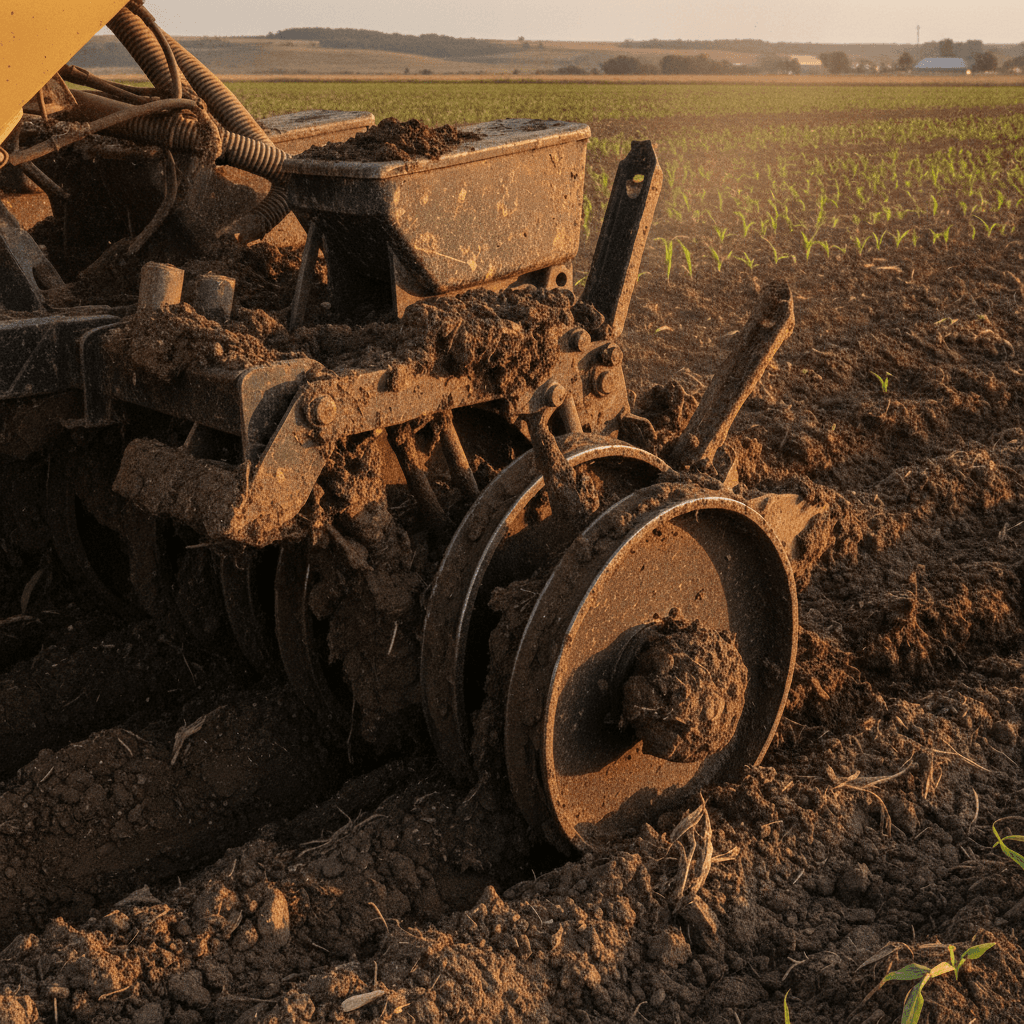
The tire lip on a gauge wheel takes a beating no matter where you farm, but heavy clay soils accelerate that wear in a specific way. Clay sticks rather than sheds. When it packs between the gauge wheel and the disk blade, the abrasion at the tire lip becomes constant rather than intermittent. You’re not just wearing rubber — you’re grinding it against a surface that’s been compressed into something close to concrete by the time conditions warm up enough to plant.
Mud bridging compounds the problem. A plugged gauge wheel isn’t just a nuisance — it changes your effective planting depth, and once depth consistency goes, so does stand uniformity. In a short South Dakota planting window where you’re trying to get corn and soybeans in across hundreds of acres in a matter of days, stopping to knock mud out of row units is a real yield and profitability hit, not just an inconvenience.
What competitors rarely address specifically is the interaction between soil type and component longevity. Most product pages show wear data from average conditions. That’s useful, but it’s not the full picture for a farmer dealing with the particular brutality of clay soils from central South Dakota through the Corn Belt.
What the Steel Ring Actually Does — and Why Clay Conditions Make the Built-In Scraper Matter
Jung Enterprise’s patented steel ring (US Patent 11,707,013 B2 and related patents) is designed to do two things at once: protect the tire lip from direct abrasive contact with the soil, and scrape mud off the gauge wheel as it rotates. That second function is the one that gets underplayed by most marketing materials, and it’s the one that matters most in heavy clay.
A lot of competing products address tire lip wear, but they don’t include a built-in scraper. That means if you’re running something like a traditional rubber or composite edge protector in gumbo ground, you’ve solved part of the wear problem but left the plugging problem wide open. You end up buying a separate scraper kit, adding installation time, adding another failure point, and still fighting mud between passes.
The steel ring mounts with six screws — straightforward install, no special tooling. The scraper function is built into the ring itself, so there’s no separate piece to adjust, lose, or replace mid-season.
Thirteen Thousand Acres and 1/16 of an Inch — What Field Testing Actually Shows
It’s easy to say a part is durable. The more useful number is how much it actually wears over a documented run of acres. After 13,000 planted acres across three seasons, Jung Enterprise’s steel rings showed only 1/16 of an inch of wear. That’s the kind of figure that tells you something real about expected service life — and about whether you’re looking at a one-season part or something that earns its cost over multiple years.
For a farmer near Mitchell running a 16- or 24-row planter across corn and soybean acres, the math on replacement frequency and per-acre cost of the ring looks considerably better than cycling through OEM rubber gauge wheel tires or unprotected aftermarket options every season. And in clay soils, where wear rates are higher, a part with this kind of documented durability carries more weight than one with nothing but a spec sheet behind it.
What Competitors Don’t Tell You About Soil-Specific Performance
Reviewing what’s available from the main players in the gauge wheel and row unit accessory space, one gap stands out clearly: almost none of them give you soil-specific performance data. You’ll find general wear comparisons, field demonstrations in typical Midwest conditions, and plenty of product photography. What you won’t find is a direct conversation about how a product behaves specifically in heavy clay, gumbo, or high-moisture soils — the exact conditions that push equipment hardest and push farmers toward looking for aftermarket solutions in the first place.
That’s a real gap. A farmer south of Mitchell dealing with heavy Davison County soils is asking a different question than a farmer on lighter ground in Iowa. If a product page can’t speak to that difference, you’re left guessing whether the durability claims translate to your conditions.
Jung Enterprise builds and tests in South Dakota. The Northern Plains and the specific soil challenges that come with it are the home environment, not a secondary market. That context matters when you’re trying to figure out whether a part was engineered for conditions like yours or just marketed toward them.
Compatibility: Does It Fit Your Planter?
The steel ring is designed to fit gauge wheels across multiple OEM brands and gauge wheel sizes — planters, air seeders, and no-till drills. If you’re running a major brand of row-crop planter or a no-till drill and want to know whether it fits your specific setup before ordering, reach out directly and get a straight answer rather than guessing from a compatibility chart.
Frequently Asked Questions — Steel Rings in Heavy Soil Conditions
Will the steel ring scraper function hold up in heavy clay without bending or losing contact?
Yes. The ring is designed with enough rigidity to maintain scraper contact under the lateral forces that clay soil creates. Unlike rubber or flexible scrapers that can deform under clay loading, the steel construction keeps consistent contact through the rotation cycle.
How hard is installation on a 24-row planter?
Six screws per ring. A farmer or equipment operator comfortable doing their own row unit maintenance can install these without special equipment. Most operators complete a full planter in a single shop session.
Do I need to buy a separate mud scraper if I run the steel ring?
No. The scraper function is integrated into the ring itself. That’s one of the core differences from competing products that protect the tire lip but leave you sourcing a scraper separately.
What’s the realistic service life in South Dakota clay soils?
Field testing shows 1/16 of an inch of wear after 13,000 acres across three seasons. Your specific results will vary with soil abrasiveness, planting conditions, and row unit settings — but that’s the documented baseline from real field use, not a lab projection.
Can I buy direct from Jung Enterprise or do I need to go through a dealer?
Both. Jung Enterprise sells direct and also works with ag dealers and distributors. If you’re a dealer in the Mitchell area or elsewhere in South Dakota looking to carry the line, that conversation is welcome too.
Ready to Stop Replacing Tires Every Season?
If clay soils near Mitchell or anywhere across South Dakota are chewing through your gauge wheel tires faster than they should be — or if mud plugging is costing you hours during planting — the steel ring is worth a serious look. Review the full product line here, or call Jung Enterprise at (605) 281-0497 and talk through whether it’s the right fit for your planter setup. No sales pitch, just straight answers from a shop that builds for these conditions.