
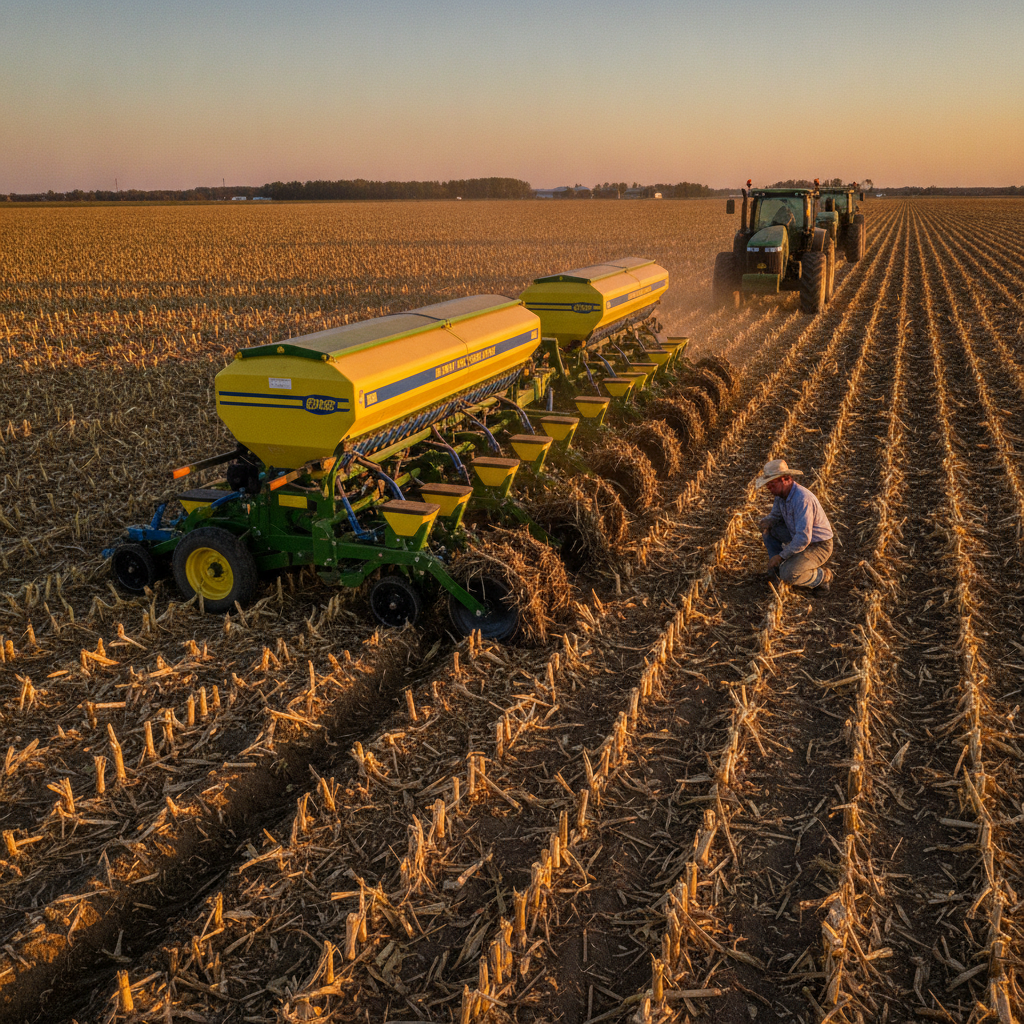
How Do Strip-Till Farmers Near Fargo Know Whether Their Air Seeder’s Gauge Wheel Is Actually Shedding Residue Between Passes — Or Just Packing Crop Debris Into the Seed Trench?
If you’re strip-tilling into heavy corn or sunflower stubble near Fargo and your gauge wheels are the solid or semi-closed spoke design that came stock on your air seeder, there’s a real chance they’re collecting and dragging residue rather than shedding it. The problem doesn’t always announce itself with a plugged row unit. More often, it shows up later — in uneven emergence, shallow seeds in the rows where residue got pushed down first, or stands that look inconsistent field to field when soil conditions haven’t changed. The gauge wheel is doing its job holding depth, but it’s also doing something it shouldn’t: acting like a residue funnel straight into the trench.
Why Residue Shedding Is a Bigger Problem for Air Seeders Than Most Operators Realize
Planters running 24 or 36 rows across a corn field are dealing with residue, no question. But air seeders — especially the wide-frame setups common across North Dakota and into western Minnesota — are covering a lot more ground per pass and working through residue that hasn’t been managed by a row cleaner up front the same way a dedicated row-crop planter might handle it. In strip-till systems near Fargo, you’re often running into standing stubble that’s been sitting since fall, sometimes flattened and matted by snow and freeze-thaw cycles all winter. That kind of residue doesn’t flow around equipment the way fresh fall stubble does. It wraps, it strings, and it packs.
When a gauge wheel with limited spoke clearance rolls through that mat, it picks up residue and carries it. If the spokes are straight or the openings between them are narrow, there’s nowhere for the material to exit before it gets dragged down alongside the seed. The trench doesn’t close cleanly around seed — it closes around seed and a plug of debris, and germination suffers for it.
What Solid and Straight-Spoke Gauge Wheels Miss in Strip-Till Conditions
Most OEM gauge wheels on air seeders weren’t engineered specifically for heavy-residue strip-till environments. They were designed to hold depth and handle normal field conditions. That’s a reasonable baseline, but it’s not the same as being designed to actively shed residue in the kind of conditions farmers around Fargo and across the Northern Plains deal with every spring.
Solid-face gauge wheels are the worst offenders — they give residue nowhere to go. Straight-spoked designs are better but still tend to accumulate debris between passes in matted or wet residue conditions. The result is the same either way: material packs against the wheel, the trench gets contaminated, and you lose seed-to-soil contact in exactly the rows you can least afford it.
What you actually need in a high-residue strip-till setup is a gauge wheel designed with curved, open spokes that create centrifugal clearance as the wheel turns — so residue that gets picked up is thrown out rather than held. That’s the core design principle behind Jung Enterprise’s Curved Spoked Gauge Wheels, which were built specifically to address this problem in field conditions, not just on paper.
The Gap Most Competitor Products Don’t Address Directly
Here’s something worth noting: if you look at what’s available from most gauge wheel suppliers, residue shedding in air seeder strip-till applications is barely addressed. Most product pages focus on depth control, tire wear, and compatibility — which all matter — but the specific question of whether the wheel design actively sheds crop residue in heavy-stubble conditions is almost never answered directly. You get photos and compatibility charts, not field data on how the wheel behaves when it’s rolling through matted corn stalks at 5 mph.
That’s a real gap for farmers near Fargo and across North Dakota, where strip-till into corn and sunflower stubble is common and the spring window is short enough that you can’t afford to discover the problem mid-field. Jung Enterprise’s curved spoked design has been field-tested across 13,000 planted acres with documented wear of only 1/16 inch over three years — and the open-spoke geometry is the reason residue clears rather than packs. These are made in America, patented, and built for the conditions farmers in this region actually face.
How to Check Whether Your Current Gauge Wheel Is Actually Shedding Residue
You don’t need a lot of tools to get a quick read on this. After your first pass through a heavy-residue field, stop and check a few row units:
- Look at the spoke faces. If residue is packed between the spokes or wrapped around the hub, the wheel isn’t shedding — it’s collecting.
- Check the trench before it closes. Dig into a few seed slots right behind the gauge wheel. If you see residue mixed in with soil at seed depth, that’s coming from the wheel, not just surface contamination.
- Watch for inconsistent trench depth. Residue buildup against the wheel changes its effective rolling diameter slightly over the course of a pass, which can drift your seeding depth without any mechanical failure on the row unit.
- Compare rows in heavy-residue zones versus clean zones. If emergence is consistently worse where stubble was thick, the gauge wheel is likely part of the cause, not just the soil conditions.
If any of these checks point to a problem, the solution isn’t to slow down or run fewer acres per day. It’s to run a wheel designed to handle the conditions. Jung Enterprise, based in Ipswich, South Dakota, has been building and refining this hardware for exactly these field conditions across the Northern Plains.
FAQ: Air Seeder Gauge Wheels and Residue Management in Strip-Till
Will a curved spoked gauge wheel work on my existing air seeder, or does it require modifications?
Jung Enterprise’s curved spoked gauge wheels are designed to fit multiple OEM air seeder and planter configurations without requiring custom modifications. The best way to confirm compatibility for your specific machine is to contact us directly with your make and model — we’ll tell you straight whether it fits or not.
How much residue buildup is normal, and when does it become a problem?
Some light residue contact during a pass is unavoidable. The problem starts when residue is accumulating between spokes and carrying into the trench rather than clearing before the next rotation. If you’re stopping mid-field to clear gauge wheels by hand, that’s not normal — and it’s costing you time during a window when every hour matters.
Do I need a separate residue manager or row cleaner if I switch to a curved spoked gauge wheel?
In most strip-till setups, a well-designed open-spoke gauge wheel reduces residue issues at the trench significantly. Whether you still need row cleaners depends on your residue load and tillage system. A curved spoked gauge wheel won’t replace a row cleaner in extreme residue conditions, but it will stop the gauge wheel itself from being part of the problem.
Does the curved spoked design affect planting depth accuracy?
No — depth control is the primary function, and the curved spoke design doesn’t compromise it. The geometry is engineered to maintain consistent ground contact and precise depth control while adding residue-shedding capability. That’s not a tradeoff; it’s the point of the design.
I farm near Fargo and run a large-frame air seeder across multiple fields in a short spring window. How do I know these wheels can keep up?
13,000 planted acres with only 1/16 inch of measured wear over three years is the answer. These aren’t lab numbers — they’re field-tested results. If you’re covering serious ground every spring, that durability matters more than any spec sheet.
Ready to Stop Guessing Whether Your Gauge Wheels Are Actually Doing Their Job?
If you’re running strip-till near Fargo or anywhere across North Dakota, South Dakota, or western Minnesota and you’ve had uneven emergence you can’t fully explain, it’s worth taking a hard look at what your gauge wheels are doing in residue. Jung Enterprise builds patented, American-made gauge wheels and related planter hardware specifically for the conditions farmers in this region deal with every spring. Reach out to our team in Ipswich and tell us what you’re running — we’ll help you figure out whether a change makes sense before next planting season, not after.
Contact Jung Enterprise at jungenterprise.net/contact-us, call us at (605) 281-0497, or email help@jungenterprise.net.