
How Do Strip-Till Farmers Near Ipswich Know Whether Their Gauge Wheel Is Actually Staying Level Through a Berm — Or Just Riding the Ridge and Missing Seed Depth?
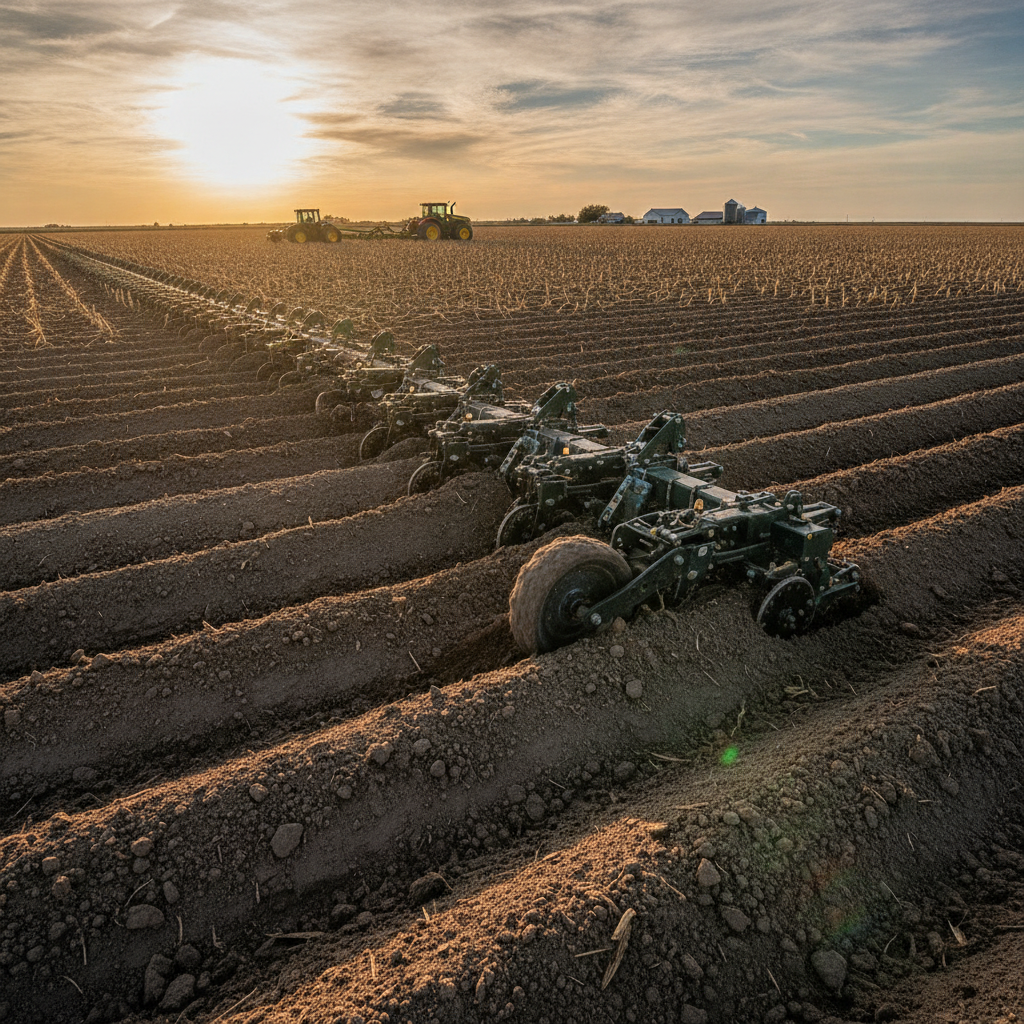
Strip-till farmers near Ipswich deal with a depth-control problem that doesn’t get talked about much in gauge wheel circles: the berm itself. When you’ve built a good strip in the fall, that raised bed is exactly where you want your seed come spring. But if your gauge wheel is rolling over the crown of that berm instead of tracking the furrow floor consistently, you can lose a half-inch to a full inch of planting depth before you’ve even made it to the end of the first pass. That’s not a calibration problem. That’s a gauge wheel problem — and most of the content out there on gauge wheels never touches it.
What Strip-Till Actually Demands From a Gauge Wheel
In a conventional-till or no-till setup, the soil surface is relatively uniform. Your gauge wheel is riding a flat-enough plane, and depth control is mostly about downforce and tire condition. Strip-till changes that equation. You’ve got a prepared strip — typically 6 to 10 inches wide and raised 2 to 4 inches above the interrow — and you’re asking your row unit to ride that berm accurately enough to hit 1.5 to 2 inches of seed depth, pass after pass, across a field that may have settled unevenly over winter.
The gauge wheel needs to do three things well in this environment:
- Maintain consistent contact with the berm surface without bouncing off crowns
- Shed mud from the spoke faces fast enough that it doesn’t pack up and artificially raise the wheel off the soil
- Hold the disk opener at the correct depth even as the berm profile changes across the field
A solid-face gauge wheel that’s picking up clay on every revolution is not doing any of those things reliably. Across the Northern Plains — in the heavier soils south of Aberdeen or east of Huron — mud pack on a solid-face wheel can accumulate fast enough in a wet April to effectively raise the gauge wheel by a quarter inch or more mid-field. You won’t see it happening. You’ll see it in your emergence maps two weeks later.
Why This Is a Gap Nobody Covers Well
Search the major planter parts competitors and you’ll find plenty of content on gauge wheel depth control for flat ground, sidewall compaction in heavy soils, and row-by-row depth variation across a toolbar. What you won’t find is a serious discussion of how gauge wheel design interacts with strip-till berm geometry. That’s a real problem, because strip-till adoption has been growing steadily across South Dakota, North Dakota, Minnesota, and Nebraska, and the farmers running strip-till systems have specific needs that generic gauge wheel content doesn’t address.
The short answer is that an open-spoke gauge wheel design handles strip-till conditions better than a solid-face design. When the spoke faces are curved and the spaces between them are open, mud has somewhere to go. It doesn’t pack. The wheel keeps rolling clean, which means it keeps riding the berm surface accurately instead of riding a mud shell around the tire.
What to Check Before Planting Season if You’re Running Strip-Till
If you pulled your planter out of the shed after a wet fall and haven’t looked closely at your gauge wheels yet, here’s what matters before you hit the first strip:
- Check the tire lip. The edge of a worn or cracked gauge wheel tire lip doesn’t seat the disk opener cleanly against the furrow wall. On a berm, that problem is amplified because the soil isn’t packed uniform like a tilled seedbed. If the tire lip is showing visible wear or cracking, you’re already behind.
- Check the spoke faces for mud packing history. If you pulled the planter in last fall with mud caked between the spokes, and those spokes are solid-face, that’s what you’re dealing with again this spring. A curved open-spoke design sheds that material as the wheel turns.
- Check your depth setting on the actual strip profile, not just flat ground. Set your planter depth in the field on a representative strip — not in the driveway. Berm crowns and flat ground behave differently under the row unit.
- Check that your gauge wheel isn’t dislodging under field conditions. Strip-till ground has more lateral variation than flat-tilled ground. A gauge wheel that’s not properly retained can shift under side load as the row unit tracks across a berm that’s slightly off-center.
That last point matters more than most people think. A wheel retainer that keeps the gauge wheel firmly seated on the axle isn’t just a safety item — it’s a depth-control item. If the wheel has any lateral play, it introduces variability in how the disk opener is guided, and on a strip-till berm that variability compounds fast.
How Jung Enterprise’s Parts Address Strip-Till Conditions
The curved spoked gauge wheels from Jung Enterprise were designed with open-spoke geometry specifically to prevent mud pack buildup during high-residue, high-moisture field conditions — the exact conditions you’re dealing with in early May across the Northern Plains when you’re trying to hit a strip-till window. The curved spoke design gives mud a path off the wheel face instead of letting it layer up into a hard shell.
The steel ring that mounts on the tire lip handles a separate but related problem. In strip-till, your gauge wheel tire takes more abuse than in conventional till because it’s rolling over partially consolidated soil edges and crop residue concentrated in the interrow. The steel ring protects the tire lip from that wear, doubles as a built-in scraper so you don’t need a separate scraper part, and mounts with six screws without requiring any special tools or modifications. After 13,000 planted acres over three years of field testing, wear measured at only 1/16 inch. In strip-till conditions where the tire lip takes constant lateral stress from berm edges, that durability matters.
And if you’re dealing with a gauge wheel that has any history of dislodging under load — especially on a strip-till toolbar where the row unit is constantly navigating berm contours — the wheel retainer is a straightforward fix. It’s designed to keep the gauge wheel from coming off the planter mid-run, which in strip-till means you’re not losing track registration on a pass you already paid to build last fall.
Fargo, Aberdeen, and Other Strip-Till Markets to the North
Farmers running strip-till systems near Fargo and across the Red River Valley deal with some of the heaviest clay soils in the region — conditions where gauge wheel mud pack is a near-constant problem from the time the field thaws until it dries out enough to carry equipment. The same open-spoke, mud-shedding design that matters in the heavy gumbo around Ipswich and Aberdeen applies equally up there. The planting window is just as tight, and the berm geometry is just as unforgiving if your gauge wheel isn’t tracking it cleanly.
If you’re a dealer in that corridor stocking parts for strip-till operators, the conversation with your customers is different than the conversation for conventional-till. They’re not asking generic depth-control questions. They’re asking whether the wheel will stay clean on a wet berm and whether the tire lip will hold up across a high-acre spring run. Those are answerable questions with the right parts on the shelf.
Frequently Asked Questions
Does strip-till change what gauge wheel size I should be running?
Not necessarily — the gauge wheel diameter you need is still determined by your row unit and disk opener setup. But strip-till does change which design features matter most. Open-spoke mud shedding becomes more important, and tire lip durability matters more because the wheel is navigating more surface variation per acre than on flat-tilled ground. See all Jung Enterprise gauge wheel options to match your row unit.
My gauge wheel looks fine but I’m getting variable emergence in my strips. Could it be the wheel?
Yes, it could be. Variable emergence in strip-till often traces back to inconsistent seed depth, which can come from mud pack artificially raising the gauge wheel, tire lip wear that’s compromising disk-to-furrow wall contact, or a wheel that has lateral play from a worn or missing retainer. It’s worth pulling the planter before the season starts and checking all three.
Can I use the same steel ring on a strip-till planter that I’d use on a no-till drill?
Jung Enterprise’s steel ring is compatible across planters, air seeders, and no-till drills, provided the gauge wheel size matches. The mounting is consistent — six screws, no special modifications. The scraper function works the same way regardless of whether you’re running strip-till or no-till.
Does the wheel retainer need to be replaced if I switch planters?
The retainer is sized to the gauge wheel and planter configuration. If you’re switching machines or swapping row units, confirm the fitment before the season. It’s a simple check, but it matters — a retainer that’s close but not right is not the same as one that’s confirmed compatible.
What’s the honest tradeoff between open-spoke and solid-face gauge wheels for strip-till?
Open-spoke wheels shed mud better but have less tire surface area in contact with the berm at any given moment. In practice, that tradeoff goes heavily in favor of open-spoke in wet strip-till conditions because mud pack on a solid-face wheel is a larger accuracy problem than the slight contact surface difference. On dry, firm berms, the difference is minimal either way.
Talk to Jung Enterprise Before Your Next Strip-Till Season
If you’re running strip-till near Ipswich or anywhere across South Dakota, North Dakota, Minnesota, or Nebraska and you’re not confident your gauge wheels are tracking your berms accurately — or if you’ve been dealing with variable emergence you can’t fully explain — it’s worth having the conversation before planting starts. Jung Enterprise builds patented, American-made gauge wheels, steel rings, and wheel retainers specifically for the conditions farmers in this part of the country deal with every spring. No overseas parts. No generic spec sheets. Real field-tested performance.
Contact Jung Enterprise here to ask about fitment for your planter setup or to find out where to source parts before the season opens up.