
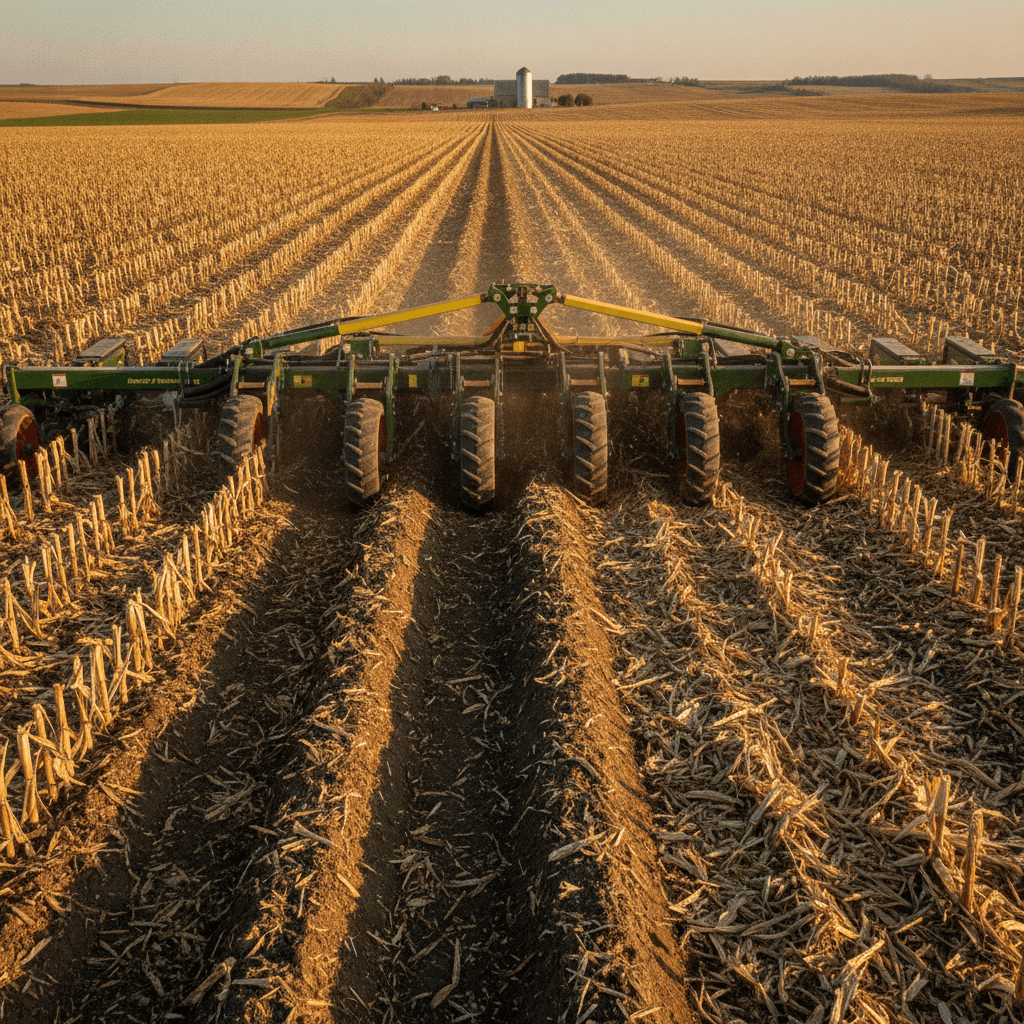
How Do Strip-Till Farmers Near Sioux Falls Know Whether Their Planter’s Gauge Wheels Are Actually Tracking the Strip — Or Wandering Off the Berm Into Untilled Ground?
If you’re strip-tilling corn near Sioux Falls or across eastern South Dakota, you already know the system only works when the planter stays on the berm. The strip is where all the fertility is concentrated, the soil structure is right, and conditions are set up for a strong seedbed. The moment your gauge wheels drift off the berm — even a couple of inches — you’re planting into unworked ground, and your seed placement, depth consistency, and early emergence all take a hit. Most gauge wheel content online focuses on depth control in conventional or no-till systems. Very little of it addresses what strip-till specifically demands from your gauge wheels, and that’s the gap this article is meant to fill.
Why Strip-Till Creates a Different Set of Gauge Wheel Problems
In conventional tillage or straight no-till, your gauge wheels are working on a relatively uniform surface. Depth control matters, but lateral tracking isn’t usually an issue — the whole field is either tilled or it isn’t. Strip-till changes that equation completely. Now you’ve got a prepared strip sitting 2 to 4 inches above the surrounding untouched soil, and the edge of that berm acts as a constant invitation for your gauge wheels to roll off course.
Here’s what actually happens in the field: if your gauge wheels have worn flat, lost their profile, or are running on compromised tires with uneven compression, they don’t hold the strip cleanly. One side of the row unit settles slightly lower than the other, the opener tilts, and your seed goes in at an angle or at inconsistent depth. By the time you see it in stand counts two weeks later, you’ve already planted 50 or 80 acres of compromised rows.
Wet springs make this worse. Across Minnesota, Iowa, and South Dakota’s eastern counties, spring planting windows are short and soils are often saturated when it’s finally time to run. The berms you built in the fall can absorb enough moisture by April that the edges soften and don’t offer the firm lateral support you’re counting on. Gauge wheels that are in marginal condition can’t compensate — they just follow the path of least resistance.
What Gauge Wheel Condition Has to Do With Berm Tracking
Tracking the strip isn’t just a steering or GPS guidance problem — it’s also a gauge wheel condition problem. Here’s why: your gauge wheels are what make contact with the berm surface. If the tires are cupped, cracked, or have uneven wear, the contact patch is inconsistent from one side of the row unit to the other. That introduces lateral play that no amount of GPS correction can fix because the issue isn’t where the tractor is going — it’s where the row unit is sitting relative to the strip surface.
Spoke design matters here too. Solid or semi-open gauge wheels that pack mud between the spokes add uneven weight and change how the wheel contacts the berm. In wet conditions, a gauge wheel carrying a plug of gumbo clay on one side can actually tilt the row unit laterally. Curved spoked gauge wheels address this directly — the open spoke geometry sheds mud and residue rather than collecting it, so the wheel maintains consistent contact with the strip surface throughout the pass.
The Steel Ring Factor Most Strip-Till Operators Overlook
Strip-till farmers often focus their attention on the opener, the closing wheel, or row unit downforce when troubleshooting stand problems. The gauge wheel tire lip rarely gets scrutinized. But here’s the thing: if the lip of your gauge wheel tire is worn or deformed, the tire doesn’t seat consistently on the strip berm. You lose the clean edge that keeps the wheel from rolling inward or outward off the strip.
Jung Enterprise’s patented Steel Ring protects the tire lip directly — it wraps the lip and doubles as a built-in scraper so mud doesn’t build up on the wheel face. That scraper function matters in strip-till because berm edges tend to accumulate loose, wet soil that smears onto the wheel with every rotation. The Steel Ring clears it. The patented design (US Patent 11,707,013 B2) mounts with six screws and has been field-tested to only 1/16″ of wear after 13,000 planted acres across three seasons. That’s not a lab number — that’s real-world proof from working planters in conditions similar to what you’re running through in eastern South Dakota and across the Minnesota border.
No competitor currently sells a steel tire lip protector that also functions as an integrated scraper in a single part. That combination — protection plus cleaning — is what makes it relevant to strip-till operators who can’t afford to stop and clean wheels mid-field during a narrow planting window.
How to Diagnose Whether Your Gauge Wheels Are Actually Tracking the Strip
You don’t need elaborate technology to check this. Walk 50 feet behind the planter on a fresh pass and look at where the seed trench is positioned relative to the center of the berm. If it’s consistently shifted to one side — even 1.5 to 2 inches — something is off. Check for these specific conditions:
- Uneven tire wear side to side: If one gauge wheel is more worn than the other on the same row unit, the row unit is running canted.
- Mud buildup on one side of the gauge wheel face: Indicates the scraper isn’t functioning and one side is carrying more material weight than the other.
- Visible lip cracking or deformation: A compromised tire lip won’t hold a consistent berm contact profile.
- Gauge wheel retainer looseness: If the wheel retainer isn’t holding the gauge wheel firmly seated on the hub, you can get micro-movement that compounds into tracking drift across a long field pass.
If you’re seeing any of these, address them before the next planting pass — not between fields, not at the end of the day. In a short South Dakota planting window, one day of compromised gauge wheel performance across a 24-row planter is a lot of acres to replant or accept poor stands on.
A Note for Dealers Near Brookings and the Eastern Corridor
Strip-till adoption has been climbing steadily in the eastern South Dakota and southwestern Minnesota corridor. Ag dealers and co-ops near Brookings who are advising strip-till customers need parts that are genuinely designed for the demands of that system — not just OEM replacements or general-purpose gauge wheel upgrades. Jung Enterprise works directly with dealers and distributors. If your customers are asking about strip-till gauge wheel performance and you don’t have an answer that goes beyond the standard OEM pitch, that’s worth a conversation.
Frequently Asked Questions
Do gauge wheels actually affect whether a planter tracks a strip-till berm?
Yes. Worn, deformed, or mud-loaded gauge wheels change the lateral contact profile of the row unit against the berm. Even small inconsistencies in tire lip shape or wheel balance cause the row unit to drift off the strip, especially in soft or wet berm conditions.
Will curved spoked gauge wheels improve strip-till performance compared to standard OEM wheels?
In most cases, yes — particularly in wet or residue-heavy conditions. The open spoke design prevents mud and debris from accumulating between the spokes, which keeps the wheel running balanced and in consistent contact with the berm surface.
Does the Steel Ring help with strip-till specifically, or is it mainly for no-till?
It’s field-relevant for both. The tire lip protection and integrated scraper function are useful anywhere gauge wheels are working in wet or residue-laden conditions — strip-till, no-till, and even conventional systems with heavy corn residue. The key benefit for strip-till is that it keeps the tire lip in consistent shape so the wheel holds its position on the berm.
How hard is it to install the Steel Ring or new gauge wheels before planting season?
The Steel Ring mounts with six screws — no special tools, no machining. Curved spoked gauge wheels swap in where your existing wheels mount. Most operators handle it in the shop without outside help. Jung Enterprise can walk you through fitment questions if you’re not sure about compatibility with your specific planter model.
Can I order directly from Jung Enterprise, or do I need to go through a dealer?
Both options are available. Jung Enterprise sells direct to farmers and also works with ag dealers and distributors. If you’re near Sioux Falls, Brookings, or anywhere in South Dakota, you can reach out directly through the contact page and get a straight answer on what fits your equipment.
If strip-till is part of your operation and you’re not sure your gauge wheels are actually keeping you on the berm, it’s worth taking a hard look before the planting window opens. Jung Enterprise is based in Ipswich and built these parts for the conditions farmers in this region actually deal with. Reach out here with your planter model and we’ll help you figure out what you need.