
How Do Farmers Near Ipswich Know Whether Their Wheel Retainer Is Actually the Right Design — Or Just a Generic Part That’ll Let the Gauge Wheel Walk Off Mid-Field?
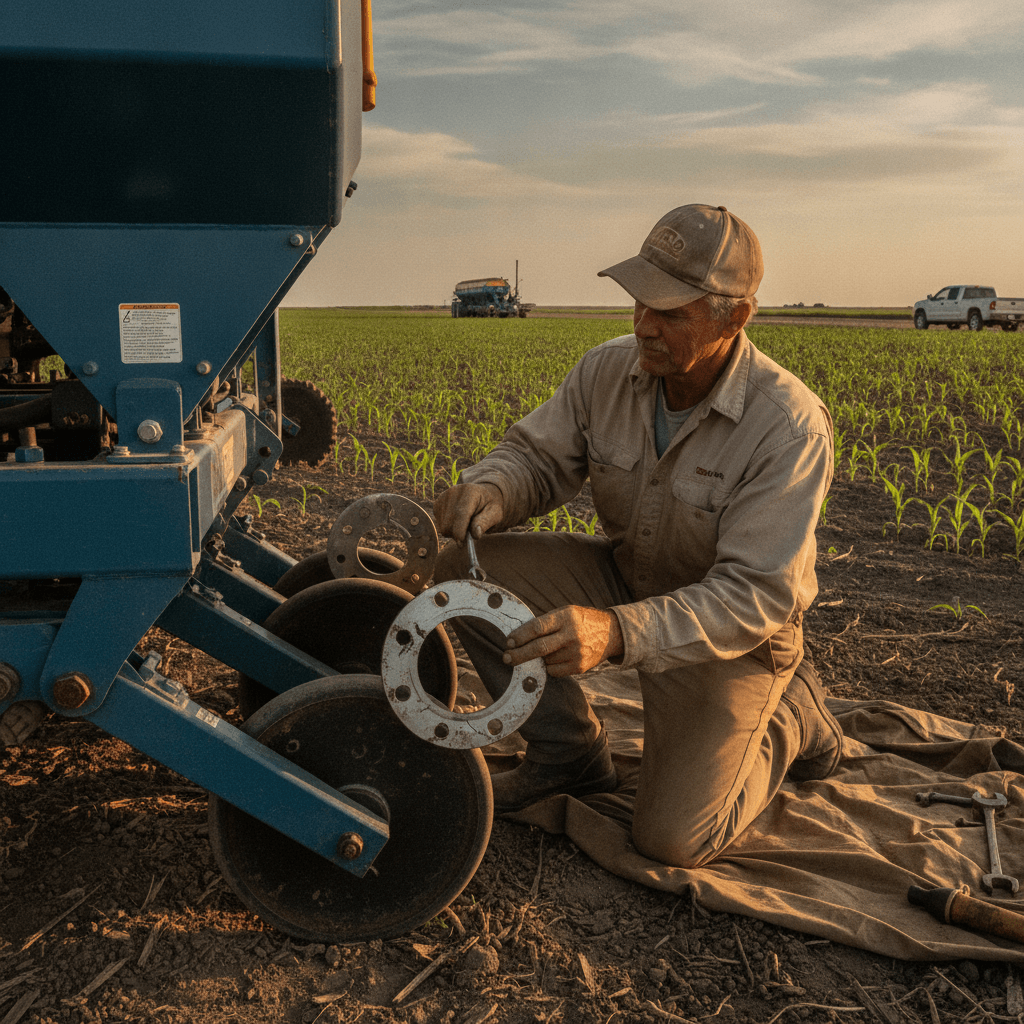
If your gauge wheel has ever walked off the axle in the middle of a planting pass, you already know how fast a small hardware problem turns into a full stop. For farmers near Ipswich and across the Northern Plains, that kind of downtime isn’t just frustrating — it comes straight out of your planting window, and in a wet spring on heavy South Dakota soils, that window doesn’t give much back. The wheel retainer is the part that’s supposed to prevent exactly that. The problem is that not every wheel retainer on the market is actually designed to hold under the lateral load and vibration that a planter or air seeder generates in real field conditions.
What a Wheel Retainer Actually Does — and Why Design Matters
The wheel retainer’s job is simple on paper: it keeps the gauge wheel locked on the spindle so it can’t walk or bounce off during operation. In practice, that job gets harder the moment you’re running through rough ground, rocky terrain, or the kind of gumbo clay soils that plague fields between Ipswich and Aberdeen in a wet spring. The lateral forces on a gauge wheel during those conditions aren’t trivial. If the retainer isn’t engineered specifically for that load — if it’s just a stamped clip or a generic fastener that happens to fit — you’re relying on fit tolerance and luck instead of an actual retention system.
The gap that most competitors in this space leave open is the question of design intent. Most product listings describe what size a wheel retainer fits. Almost none of them explain what it’s actually engineered to withstand, how it interfaces with the spindle geometry, or whether it’s been tested under real field loads. That’s a meaningful omission when the failure mode is a gauge wheel hitting the dirt mid-field.
What Separates a Purpose-Built Retainer From a Generic Clip
There are a few things worth looking at when you’re evaluating a wheel retainer — whether you’re replacing a worn-out OEM part or shopping aftermarket for the first time:
- Retention geometry: Does the retainer physically lock the wheel in place against axial movement, or does it just create friction? A true locking design doesn’t rely on the wheel staying put on its own — it mechanically prevents it from traveling off the spindle.
- Material and hardness: Stamped mild steel clips and cast zinc parts aren’t in the same category as hardened steel components designed for high-cycle mechanical loads. If the retainer itself wears or deforms before the season is out, it’s not doing its job.
- Installation reliability: A retainer that’s finicky to install correctly in a shop is nearly impossible to install correctly in the field when you’re in a hurry. The best designs go on cleanly and stay put without requiring specialty tools or a second set of hands.
- Compatibility across sizes: If you’re running multiple planter configurations or serving as a custom planter across different row spacings, you want to know whether the retainer you stock fits across your gauge wheel sizes — not just one specific OEM application.
Jung Enterprise’s Wheel Retainer is built with exactly these considerations in mind. It’s designed to prevent gauge wheel dislodgement on planters and air seeders with a clean, straightforward install — no special tools, no guesswork about whether it seated correctly. For custom planters and dealers near Sioux Falls, Watertown, or Huron who need a part that works consistently across jobs and equipment configurations, that consistency matters as much as the design itself.
The Problem With Treating the Wheel Retainer as an Afterthought
Here’s where a lot of farmers get caught. The gauge wheel takes most of the attention — the tire, the bearing, the steel ring, the scraper. The wheel retainer sits quietly at the end of the axle and doesn’t draw much notice until it fails. That’s partly a marketing problem: most manufacturers spend their content explaining gauge wheel specs and mud-shedding features, and the retainer gets a single line in a parts diagram.
But operationally, the retainer is a single-point failure that can sideline the entire row unit. A dislodged gauge wheel doesn’t just mean stopping to put it back on — it often means inspecting the spindle for damage, checking whether the bearing took any side load, and figuring out whether the retainer itself is reusable or needs to be replaced. That’s 20 to 40 minutes per row unit, minimum, and it compounds fast across a 16- or 24-row planter.
In North Dakota and Minnesota, where spring planting windows can be even tighter than in central South Dakota, a failure like that on day two of planting isn’t a minor inconvenience. It’s a real yield event if it pushes you past your optimal planting date for corn or soybeans.
Why Generic Clips and OEM Parts Often Fall Short
OEM wheel retainers are generally designed to be adequate, not exceptional. They’re a cost-managed part in a larger assembly. When you buy replacement OEM clips, you’re usually getting the same tolerance and the same material as the part that wore out. Aftermarket generic clips — especially anything sourced overseas without clear material specs — can be worse, because the dimensional tolerances on cast or stamped parts vary enough to matter at the spindle interface.
The value in sourcing from a domestic manufacturer with a defined design spec is that you know what you’re getting. Jung Enterprise builds and tests these parts in South Dakota for South Dakota field conditions. That’s not a marketing angle — it’s a practical difference when the alternative is a bag of clips that may or may not fit correctly on your specific row unit configuration.
Take a look at the full product lineup if you’re also evaluating steel rings or curved spoked gauge wheels alongside your retainer — often it makes sense to address all three while the planter is already apart in the off-season or post-harvest.
Frequently Asked Questions
What’s the difference between a wheel retainer and a standard axle clip?
An axle clip is a generic fastener that holds something in place through friction or spring tension. A purpose-built wheel retainer is engineered specifically for the axial and lateral loads a gauge wheel generates during field operation — it’s a different design intent, not just a different name for the same part.
How do I know if my current wheel retainer is failing before it lets go completely?
Check for lateral play in the gauge wheel by grabbing it and trying to push it side-to-side on the spindle. Any noticeable movement where there should be none is a sign the retainer is worn or seated incorrectly. Also look for scoring or deformation on the retainer itself — a good retainer shouldn’t show that kind of wear mid-season.
Does Jung Enterprise’s wheel retainer fit multiple planter brands and gauge wheel sizes?
Yes. The Jung Enterprise Wheel Retainer is designed for compatibility across multiple OEM planter and air seeder configurations. Contact the team directly at jungenterprise.net/contact-us to confirm fitment for your specific setup before ordering.
Is this something I can replace myself, or does it need a shop?
The Jung Enterprise Wheel Retainer is designed for straightforward field or shop installation without specialty tools. Most operators can swap one out in a few minutes per row unit once they’ve done it the first time.
Do farmers near Ipswich and Aberdeen typically replace these pre-season or only when something fails?
Both. Farmers who’ve had a gauge wheel walk off mid-field tend to add retainer inspection to their pre-season checklist after that first experience. Others replace them as part of a planned off-season maintenance cycle — especially after a wet, high-hour planting season where components saw extra stress from mud load and rough ground.
Ready to Stop Treating the Wheel Retainer as a Low-Priority Part?
If you’re near Ipswich, Huron, Watertown, or anywhere across the Northern Plains, and you want to know whether the wheel retainer you’re running is actually engineered to hold — or just stamped and shipped — reach out to Jung Enterprise directly. We can help you confirm fitment, talk through what you’re seeing in the field, and get you the right part before planting season puts everything to the test.
Call (605) 281-0497, email help@jungenterprise.net, or visit jungenterprise.net/contact-us to get started.