
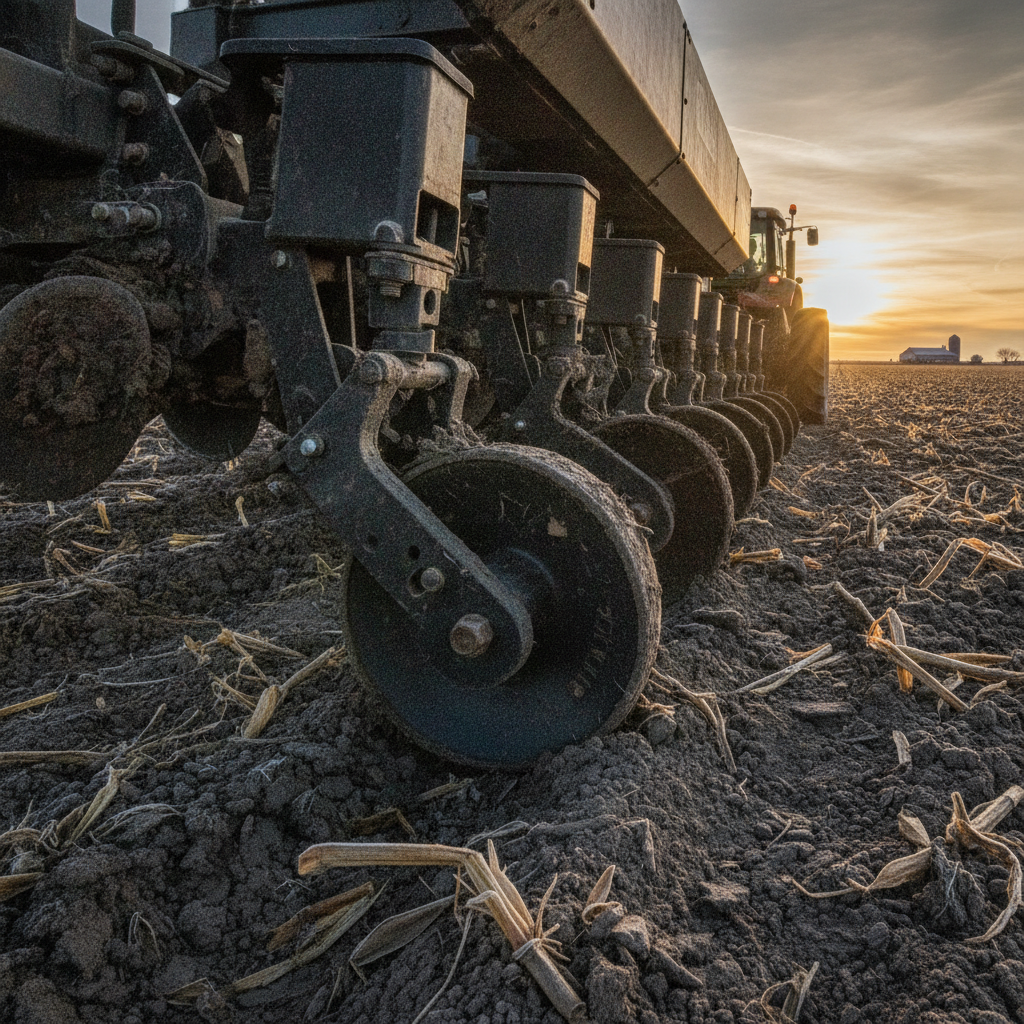
How Do No-Till Farmers Near Bismarck Know Whether Their Planter’s Wheel Retainer Is Actually Engineered for Northern Plains Soil Conditions — Or Just a Generic Part That Works Until the Ground Gets Tough?
If you’re running a no-till drill or planter out of the Bismarck area, the short answer is this: most wheel retainers on the market were not specifically engineered for what you’re dealing with. They were designed to hold a gauge wheel on under average conditions — not to handle the lateral stress that comes with pushing through standing residue at a decent ground speed, working partially frozen ground in a rushed early-May start, or clawing through gumbo clay that grabs everything it touches. If your wheel retainer was just the part that came with the machine, there’s a real chance it’s already close to the threshold where it stops doing its job reliably.
What a Wheel Retainer Actually Does — and Why Northern Plains Conditions Push It Harder
The wheel retainer’s job is straightforward: it keeps the gauge wheel seated and secured on the planter or air seeder so the wheel doesn’t dislodge mid-pass. That sounds simple. But the stress that gets applied to that connection point in a no-till setup is not simple, especially in North Dakota and South Dakota soils.
When you’re planting no-till into heavy crop residue, the gauge wheel hits obstacles — clumps of corn stalks, compacted row berms from last year’s passes, chunks of frozen soil early in the season. Every one of those impacts puts a lateral force on the wheel mounting. If the retainer is a standard OEM part or a low-cost replacement, that repeated shock loading works at the connection over hundreds of acres. By the time you notice the wheel wobbling, the damage is already done and you’re burning time fixing something in the field that should have held.
Farmers in the Northern Plains also deal with a tighter planting window than most of the Corn Belt. Around Bismarck and across North Dakota, you might have ten to fourteen days where conditions are actually right to plant. Downtime doesn’t mean you plant a day late — it means you might miss the window on a portion of your acres, and that has a direct yield cost. A wheel retainer that fails at hour eight of a twelve-hour planting day isn’t just an inconvenience.
What Most Competitor Products Don’t Tell You About Wheel Retainer Engineering
Here’s a gap worth pointing out directly: most of the major gauge wheel and planter accessory brands spend the bulk of their content explaining gauge wheel design, seed depth control, and mud-shedding geometry. Very few of them talk in any depth about what makes a wheel retainer itself durable, how it handles lateral shock loads, or what failure looks like before it’s catastrophic. That’s information most farmers have to learn the hard way in the field.
What to actually evaluate when you’re looking at a wheel retainer:
- Material and construction: Is it steel, cast, or plastic? Steel retainers hold up against repeated impact loads. Plastic or low-grade cast parts can crack under the kind of shock loading you get in heavy-residue no-till passes.
- Fit precision: A retainer that’s slightly off-dimension for your gauge wheel creates play in the connection. That play accelerates wear and leads to dislodgement. The wrong part that looks close enough is not the same as the right part.
- Installation simplicity: A retainer you can swap in the field without pulling the row unit apart saves real time. If the fix takes two hours in the shop, you’ve already lost ground.
- Compatibility with your specific machine: Planters and air seeders across brands use different gauge wheel dimensions. A retainer designed for one setup may not fit correctly on another even if it looks similar.
The Jung Enterprise Wheel Retainer is built specifically to prevent gauge wheel dislodgement on planters and air seeders, with an easy install that doesn’t require pulling the whole row unit. It’s designed and manufactured in the United States, and it’s the kind of part that gets developed when the people building it have actually seen what field conditions do to gauge wheel hardware over a full season.
OEM Replacements: Why “Same as Stock” Isn’t Always Good Enough
There’s a reasonable assumption among a lot of farmers that if the OEM part lasted X years, the OEM replacement will last the same. That’s not always how it plays out. OEM parts are designed to a price point for the original machine sale — not necessarily to outlast the machine across multiple replacement cycles in demanding conditions. When you’re doing no-till in South Dakota or North Dakota clay soils, you’re asking more of that hardware than it was originally spec’d for.
The other issue with going straight back to OEM is that you don’t necessarily know if the original part was actually the right design for your specific field conditions, or just the part that was on the machine. If a wheel retainer failed or wore faster than it should have, replacing it with the same part gets you back to the same failure timeline.
What This Looks Like in a Real No-Till Operation
Consider what a typical no-till corn or soybean setup near Bismarck looks like in late April or early May. You’re dealing with soils that may still have frost a few inches down in certain fields, residue loads from last year’s corn stalks, and variable moisture across the same field. The gauge wheel is working hard — running at planting depth through that residue, maintaining consistent furrow depth, managing the soil load on both sides of the trench.
That’s the environment your wheel retainer is operating in. It’s not running in a dry, loose seed bed. If the retainer isn’t built to handle that combination of loads, you’ll know it partway through your spring run — either through a wheel you notice wobbling at a field check, or through one that comes off entirely and you find it three rows back in the field.
Jung Enterprise makes all of its products in Ipswich, South Dakota — right in the middle of the Northern Plains farming region. The same soil conditions that farmers deal with near Bismarck, across Minnesota, and down through South Dakota are the conditions that shaped the design of these parts. That’s not marketing language — it’s just where the shop is and what the product gets tested against. Learn more about how Jung Enterprise operates and what goes into their product development.
What to Check on Your Planter Before Next Season
Before you put the planter back in the field for spring, run through these checks on your wheel retainer specifically:
- Grab each gauge wheel and check for play or wobble at the mount. Any movement means the retainer is worn or not seated correctly.
- Look at the retainer itself for cracks, deformation, or obvious wear at the contact points.
- If your retainer is more than two or three seasons old on a heavy no-till operation, consider replacing it proactively. The cost of a retainer is not the cost of the downtime if it fails during planting.
- Confirm compatibility between your retainer and your specific gauge wheel — especially if you’ve swapped gauge wheels at any point and may have a mismatch.
Frequently Asked Questions
How do I know if my wheel retainer is the right part for my planter model?
Contact Jung Enterprise directly with your planter make, model, and gauge wheel size. The compatibility check is straightforward and prevents the common mistake of installing a close-but-not-correct part that creates play in the connection.
Can a loose wheel retainer affect seed depth consistency?
Yes. If the gauge wheel has play in its mount, it doesn’t hold a consistent depth reference as it moves through the soil. That translates directly to variable seed depth, which affects germination uniformity and ultimately yield.
How difficult is the install on the Jung Enterprise Wheel Retainer?
It’s designed for straightforward field installation without having to disassemble the entire row unit. Most operators can handle it without a lot of time or specialized tools.
Is this part compatible with air seeders as well as row crop planters?
Yes. The Jung Enterprise Wheel Retainer is designed for use on planters, air seeders, and no-till drills across multiple OEM brands and gauge wheel configurations.
What’s the difference between fixing a failed retainer during planting versus replacing it before the season?
During planting near Bismarck or anywhere in the Northern Plains, every hour counts. A preseason replacement costs you a part and a few minutes. A mid-season failure on a 12-hour planting day costs you time, potentially lost acres in your window, and the stress of a repair when you should be planting. The tradeoff is straightforward.
If you’re evaluating your wheel retainer situation before next planting season or stocking parts as a dealer in North Dakota, South Dakota, or Minnesota, reach out to Jung Enterprise directly. We’re in Ipswich, we know these conditions, and we can help you figure out what your operation actually needs. Contact Jung Enterprise here or call (605) 281-0497.