
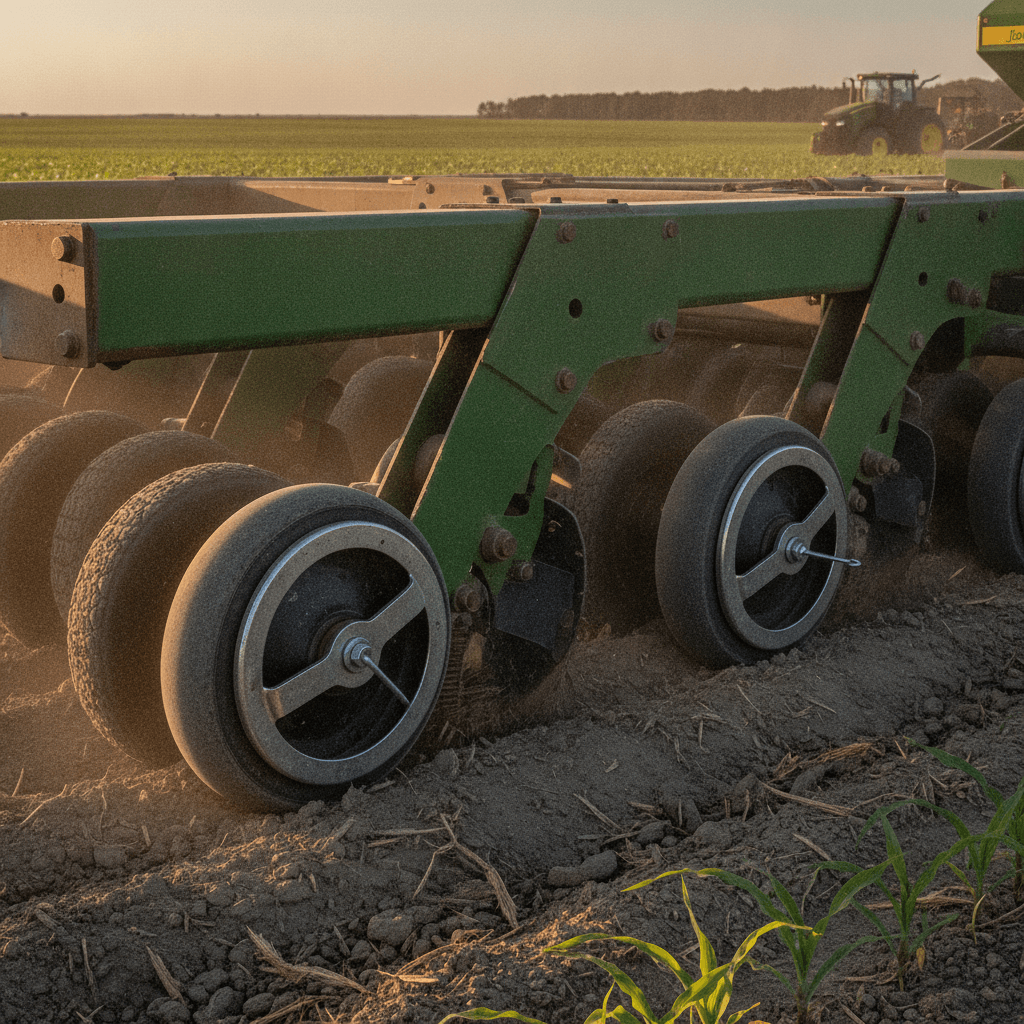
How Do Farmers Near Bismarck Know Whether Their Wheel Retainer Is Actually Preventing Gauge Wheel Dislodgement — Or Just Sitting There Looking Like It Works?
If your wheel retainer looks fine but your gauge wheel has ever walked off the hub mid-planting, then you already know the answer: looking installed and being installed correctly are two different things. For farmers near Bismarck running planters and air seeders through the gumbo soils and short spring windows that define North Dakota planting season, a gauge wheel that dislodges at the wrong moment isn’t a nuisance — it’s a row down, a delay, and potentially a yield hit on ground that was barely in condition to plant in the first place.
The frustrating part is that most operators don’t find out their wheel retainer isn’t holding until they’re already in the field. And a lot of what gets sold or shipped as a “wheel retainer” doesn’t give you a reliable way to verify it’s actually engaged and doing its job. Here’s what to look for, what actually causes dislodgement, and how to make sure your retainer isn’t just hardware that hitched a ride on your planter.
What a Wheel Retainer Is Actually Supposed to Do
A wheel retainer’s job sounds simple: keep the gauge wheel seated on the hub and prevent it from working loose or popping off during operation. That’s it. But the forces a gauge wheel deals with during a planting pass — lateral pressure in heavy soils, vibration over rough ground, repeated loading and unloading as row units float — add up fast. If the retainer isn’t positively holding the wheel in position, those forces find the slack and take advantage of it.
The most common failure mode isn’t a retainer that falls completely off. It’s a retainer that stays in place but allows the gauge wheel to move laterally just enough that it loses consistent contact with the furrow wall. You won’t always see it. You’ll feel inconsistent planting, or you’ll catch it during a row-by-row check. By then you’ve planted ground you’re not confident in.
The Signs That Your Wheel Retainer Isn’t Actually Holding
Most competitor resources on wheel retainers focus almost entirely on installation steps — and that’s useful — but what they rarely cover is how to verify the retainer is working in the field, after installation. That’s the gap. Here’s what to actually check:
- Manual lateral play at the wheel: With the planter raised and the row unit stationary, grab the gauge wheel and try to push it inward and outward along the axle. Any perceptible side-to-side movement beyond a hair’s width means the retainer is not fully engaged or is already worn. There should be firm, confident resistance.
- Witness marks on the hub: If the gauge wheel has been moving, you’ll often see wear marks or shiny rub spots on the hub or axle where metal has been contacting metal repeatedly. That’s physical evidence of movement — the retainer is not holding.
- Retainer seating position: After installation and after the first field pass, pull the row unit and look at whether the retainer is sitting in the same position it was when you put it on. If it has rotated, walked inward, or the tab has deflected, it shifted under load and is not reliably secured.
- Gauge wheel depth consistency across the field: This one’s harder to catch in real time, but if you’re seeing depth inconsistency in the trench without a bearing problem or down-pressure issue, lateral wheel movement from a loose retainer is a realistic cause. Pull the unit and check before assuming it’s something else.
Why Bismarck-Area Conditions Make This More Critical Than Average
Farmers around Bismarck and across western North Dakota deal with soils that aren’t forgiving of loose hardware. The clay-heavy ground that stays wet deep into May, combined with the gumbo that builds up on gauge wheels during wet-soil passes, puts significant lateral load on row units. When a gauge wheel is carrying a slug of packed soil on one side and hitting a firmer zone on the other, the wheel is getting pushed and pulled in ways that stress the retainer with every revolution.
That’s before you factor in the compressed planting windows common across the Northern Plains. When you’ve got five to seven days of good conditions between you and a forecast that shuts everything down, there’s no time to diagnose a wheel that’s moved off-center. You need the retainer to hold for the entire pass without you thinking about it.
The same conditions apply across much of South Dakota and into Minnesota — wet spring soils, short windows, and planters working hard in ground that hasn’t fully dried. It’s not a fringe scenario. It’s just the job.
What to Look for in a Wheel Retainer That Actually Holds
Not all wheel retainers are built with the same engagement mechanism. Some rely purely on friction or a snap fit that can walk loose under load. What you want is a design that positively locks the gauge wheel in position — one where the retainer’s geometry, not just the installer’s torque, is doing the holding work.
When you’re evaluating a wheel retainer, ask these questions before you buy:
- Does it require the wheel to be actively dislodged, or can it walk loose under normal lateral load?
- Is there a positive engagement point — a groove, tab, or channel — that holds the wheel in position mechanically rather than just through compression?
- Has it been field-tested across meaningful acreage, not just on a display unit?
- What gauge wheel sizes and OEM brands does it actually fit — and is that compatibility confirmed or just listed?
At Jung Enterprise out of Ipswich, the wheel retainer is built specifically to prevent dislodgement from the closing wheel hub on planters and air seeders — and it’s designed for straightforward installation without special tools. It fits multiple OEM configurations and is the kind of part that does its job without requiring you to check it every day you’re in the field. That’s the bar it should clear.
A Note on DIY Fixes and Generic Hardware
Some operators try to solve gauge wheel dislodgement with washers, zip ties, or improvised clips. It works until it doesn’t, and in gumbo conditions near Huron or in the heavy soils west of Fargo, “until it doesn’t” tends to happen in the middle of a planting day. A proper wheel retainer is not an expensive part. The cost of skipping it and dealing with a dislodged wheel mid-field — in time, in missed acres, in potential hub damage — is considerably higher. This is one of the lower-cost, higher-value items to get right before you start planting.
If you want to see what else goes into a complete row unit evaluation before the season starts, the full product lineup at Jung Enterprise covers steel rings, curved spoked gauge wheels, and wheel retainers — all American-made, all field-tested, and all built for the kind of conditions Northern Plains farmers actually face.
Frequently Asked Questions
How do I know if my wheel retainer fits my planter brand?
Compatibility depends on your gauge wheel size and hub design. Contact Jung Enterprise directly with your planter make, model, and gauge wheel specs — they can confirm fit before you order rather than after.
Can a wheel retainer fix a gauge wheel that’s already dislodging regularly?
If the hub or axle threads are damaged, a retainer alone won’t solve it. Inspect the hub first. If the hardware is in good shape and the retainer is simply absent or worn out, a proper replacement retainer will stop the problem.
How often should I check wheel retainers during planting season?
Give each row unit a visual and manual check at the start of each planting day and again after the first pass on any new field. Wet and abrasive soils accelerate wear and increase lateral load. Catching movement early prevents a full dislodgement later.
Do wheel retainers work on air seeders the same way as on planters?
The function is the same — keeping the gauge wheel seated on the hub — but the specific fit depends on the air seeder’s gauge wheel and hub design. Verify compatibility for your specific equipment before purchasing.
What’s the cost difference between replacing a wheel retainer now versus after a hub gets damaged?
A wheel retainer is a relatively low-cost part. Hub and axle damage from a wheel that’s been running loose — or the downtime from a wheel that walks off completely mid-field — costs significantly more. Getting the retainer right before planting is the obvious call.
Ready to Get the Right Wheel Retainer Before Planting Season?
If you’re farming near Bismarck, Fargo, Huron, or anywhere across the Northern Plains and you want to confirm your row units are actually held together the way they should be, Jung Enterprise can help. We’re a family-owned manufacturer based in Ipswich, South Dakota, and we build parts that are field-tested, American-made, and designed to hold up in the same soils and conditions you’re dealing with. Reach out to us directly to talk through your planter setup, confirm compatibility, or get questions answered before the season starts. We’d rather hear from you in February than hear about a problem in May.