
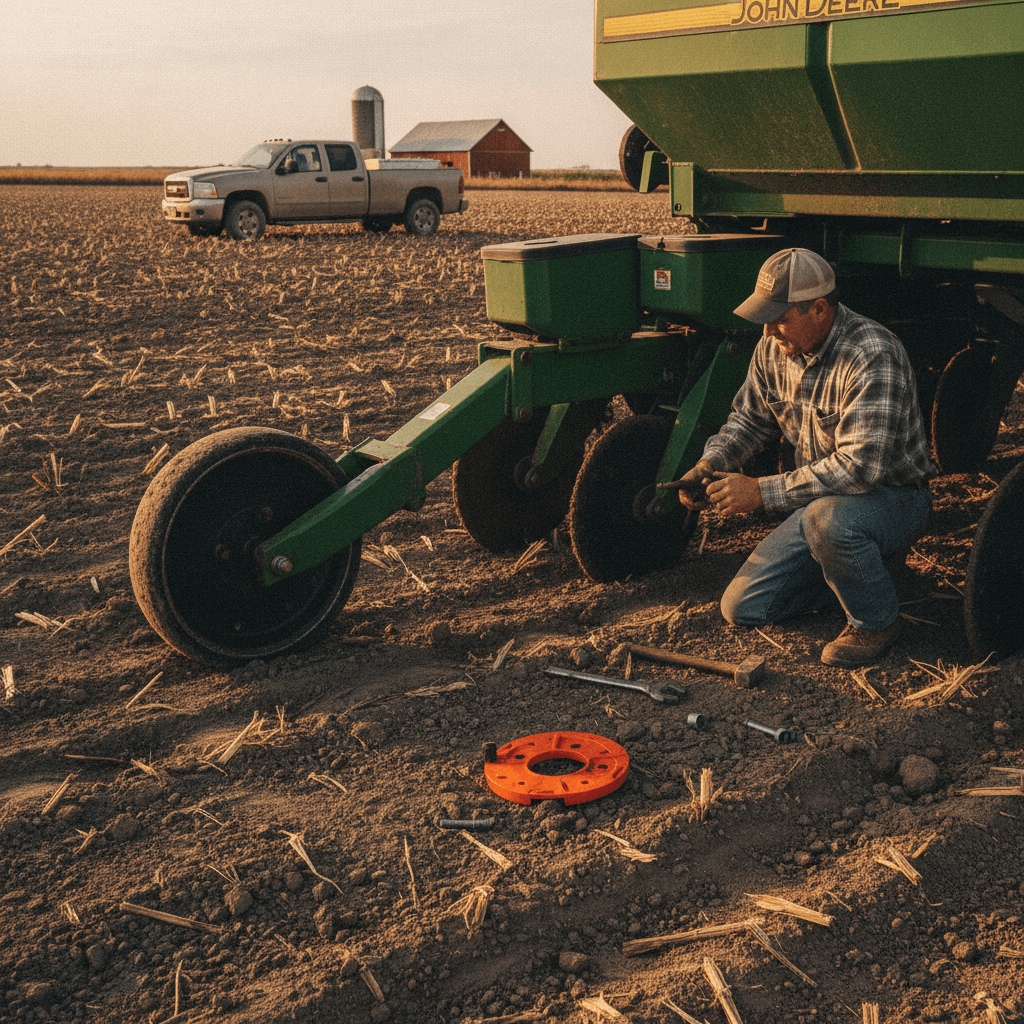
Do Wheel Retainers Actually Prevent Gauge Wheel Dislodging on No-Till Drills Near Huron?
Yes — a properly fitted wheel retainer keeps your gauge wheel seated on the axle hub where it belongs, so it doesn’t pop off mid-field and cost you a half-day of unplanned downtime. If you’re running a no-till drill or planter in the Huron area or anywhere across central South Dakota, you’ve probably dealt with this at least once. The fix isn’t complicated, but the wrong retainer — or no retainer at all — is a problem that tends to show up at the worst possible time.
- Why Gauge Wheels Dislodge in the First Place
- What a Wheel Retainer Actually Does
- The No-Till Angle That Most Competitors Don't Address
- When to Check and Replace Your Wheel Retainers
- Pairing Wheel Retainers With the Rest of Your Gauge Wheel Setup
- FAQ: Wheel Retainers for Planters and No-Till Drills
- Ready to Stop Losing Gauge Wheels Mid-Field?
Why Gauge Wheels Dislodge in the First Place
This is the part most product pages skip over. Gauge wheels don’t just fall off randomly. There are real mechanical reasons it happens, and understanding them helps you pick the right solution instead of just guessing.
On no-till drills and planters, the gauge wheel is working hard every pass — carrying down-pressure load, tracking through residue, and bouncing through field variability. Over time, the hub connection can loosen from vibration and stress, especially if the original retainer clip or snap ring has worn, cracked, or gone missing altogether. In heavy residue no-till situations, the gauge wheel can also catch debris and get levered sideways off the hub. Clay and gumbo soils — common across central South Dakota and into North Dakota and Minnesota — make this worse because the wheel is fighting constant lateral drag.
When a gauge wheel dislodges on a row unit, you’re not just looking at the time it takes to stop and remount it. You’re looking at potentially running several rows without proper depth control while you figure out something is wrong. In a tight planting window, that matters.
What a Wheel Retainer Actually Does
A wheel retainer is a mechanical fastener that locks the gauge wheel onto the hub so it can’t work its way loose or get knocked off by debris impact or lateral force. It’s a simple part with a straightforward job, but it’s one that OEM designs have historically done inconsistently — especially on older equipment that’s been through multiple seasons.
The Wheel Retainer from Jung Enterprise is designed specifically for planter and air seeder gauge wheels to prevent exactly this kind of dislodging. It installs quickly and doesn’t require special tools or major disassembly. If you’re already pulling gauge wheels to inspect or replace them before planting, adding retainers at the same time makes sense.
This isn’t a wear part — it’s a retention part. You’re not buying it because it wears out. You’re buying it because losing a gauge wheel in the field costs far more in time and frustration than the part itself.
The No-Till Angle That Most Competitors Don’t Address
Most product content from gauge wheel and planter parts companies focuses on wear, mud shedding, or depth control. That’s all legitimate. But there’s a specific problem with no-till and strip-till operations that rarely gets talked about directly: no-till drills see more lateral loading on gauge wheels than conventional planters working in clean, tilled soil.
When your drill is cutting through heavy corn or soybean residue, the gauge wheel isn’t just riding — it’s being pushed and pulled sideways constantly. That lateral stress is exactly what fatigues the hub connection over time and eventually causes a wheel to dislodge. Farmers running no-till in Huron, Aberdeen, and Watertown deal with this more than operators in lighter residue situations, and the standard OEM retainer design wasn’t always built with that load in mind.
If you’ve upgraded your gauge wheels or are running aftermarket wheels, it’s also worth checking whether your existing retainer is actually compatible. A mismatched retainer that doesn’t seat fully is almost as bad as no retainer at all.
When to Check and Replace Your Wheel Retainers
The two best times to inspect and replace wheel retainers are before planting season and after harvest — same as most gauge wheel maintenance. But specifically look for these signs that you need to act now:
- Any gauge wheel that has already come off once during a planting season — it will happen again
- Retainer clips that are visibly cracked, bent, or corroded
- Loose wheel movement when you grab and rock the gauge wheel by hand with the planter raised
- Missing retainers on rows you’ve repaired or worked on in past seasons
- Equipment that sat outside over winter without being checked
For custom planters and operators running multiple machines across a large acreage, it pays to do a row-by-row retainer check at the same time you’re doing your spring depth and down-pressure setup. It’s twenty minutes of work that can prevent a two-hour field problem.
Pairing Wheel Retainers With the Rest of Your Gauge Wheel Setup
A wheel retainer keeps the gauge wheel on the machine. But if the gauge wheel itself is worn down, cracked, or plugging with mud, you’re still fighting problems. Farmers who get the most out of a complete gauge wheel system usually address all three things together: the wheel itself, the scraper function, and the retention.
Jung Enterprise’s full product lineup includes curved spoked gauge wheels designed to shed mud rather than pack it, and steel rings that protect the tire lip from wear while doubling as a built-in scraper — no separate scraper part needed. All of it is American-made and field-tested to real-world durability standards, including just 1/16 inch of wear over 13,000 planted acres across three seasons. That’s the kind of number that matters when you’re deciding whether to spend money on parts now or deal with mid-season breakdowns later.
These parts are compatible with planters, air seeders, and no-till drills across multiple OEM brands and gauge wheel sizes — so if you’re running a mix of equipment across your operation or managing parts for multiple units, you’re not locked into a narrow fit range.
FAQ: Wheel Retainers for Planters and No-Till Drills
What’s the difference between a wheel retainer and a snap ring or cotter pin?
A snap ring or cotter pin is a basic fastener that came with OEM equipment. A dedicated wheel retainer is designed specifically to handle the load and movement patterns of a gauge wheel in field conditions — more secure, more reliable, and less likely to fatigue or fail from vibration over time.
Can I install a wheel retainer myself, or does it need a shop?
Installation is straightforward and doesn’t require special tools or a service visit. Most operators can handle it during a routine pre-season inspection. If you’re already pulling gauge wheels for any reason, adding retainers at the same time is easy.
Do wheel retainers work with aftermarket gauge wheels, or only OEM?
Jung Enterprise’s wheel retainer is designed to work with gauge wheels across multiple makes and sizes, including aftermarket and OEM wheels. If you’re unsure about fit for your specific setup, contact us and we can help you confirm compatibility before you order.
How often do wheel retainers need to be replaced?
Unlike wear parts, retainers don’t have a fixed replacement interval. Inspect them each season — before planting and after harvest — and replace any that show cracking, deformation, or signs of fatigue. If a wheel has dislodged during the season, replace the retainer on that row unit immediately regardless of how it looks.
Do Iowa and Minnesota no-till operators have the same problem with gauge wheel dislodging?
Yes. Heavy residue no-till conditions in Iowa, Minnesota, and across the Corn Belt create the same lateral loading issues as South Dakota operations. It’s not a regional problem — it’s a no-till problem. Wheel retainers are worth considering anywhere you’re running a drill or planter through heavy crop residue.
Ready to Stop Losing Gauge Wheels Mid-Field?
Jung Enterprise is based in Ipswich and builds parts specifically for the conditions Northern Plains farmers deal with — including the short, high-stakes planting windows where every hour of downtime costs real money. Whether you’re running a single planter or managing parts for a larger operation near Huron, Aberdeen, or Watertown, we can help you get the right retainers and gauge wheel components in place before the season starts.
Contact Jung Enterprise to ask about wheel retainer compatibility for your specific equipment, get ordering information, or talk through your full gauge wheel setup. We’d rather spend ten minutes answering your questions now than have you lose a wheel row three weeks into planting.