
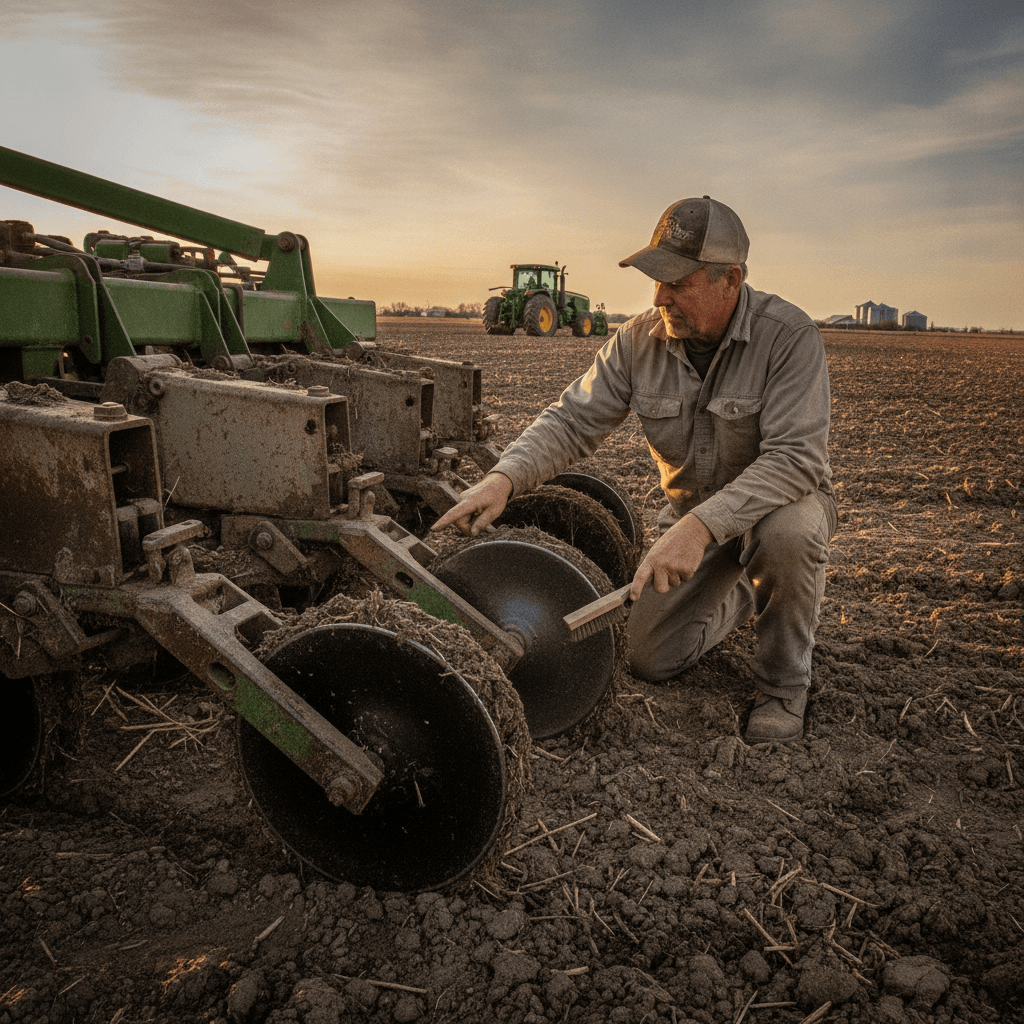
How Do Farmers Near Watertown Know When to Replace Their Planter’s Gauge Wheels — Versus When to Just Clean Them Up and Keep Going?
Here’s the honest answer: most farmers make this call based on how the wheels look, not how they actually perform. That’s a problem. A gauge wheel can look serviceable in the shop and still be costing you an inch of depth consistency in the field — and in corn or soybeans, that matters. If you’re farming near Watertown or anywhere across eastern South Dakota where wet springs and heavy soils are routine, getting this call right before planting season is worth more than most people give it credit for.
What Gauge Wheels Actually Do — And Why Wear Matters So Much
Gauge wheels aren’t just there to guide the row unit. They set and hold planting depth. The moment they stop doing that consistently — because of wear, cracking, mud buildup, or bearing slop — your seed placement goes with them. You might average out your target depth across 80 acres, but row-to-row variability kills stand uniformity, and stand uniformity is where yield is made or lost.
The problem is that wear on a gauge wheel is gradual. It doesn’t announce itself. One season it’s fine, the next it’s marginal, and by the time it’s obviously worn, you’ve already planted several hundred acres with inconsistent depth. That’s why the post-harvest inspection window — roughly September through November — is the right time to evaluate, not the week before you need to plant.
The Difference Between a Dirty Gauge Wheel and a Worn One
This is the question competitor sites don’t do a good job answering. Most resources will tell you to inspect for wear and clean off debris — but they don’t walk you through what distinguishes a wheel that just needs cleaning from one that’s actually due for replacement.
Here’s what to actually check:
- Tire lip condition: Run your hand around the inside edge of the tire where it contacts the furrow wall. If the lip is rounded, cracked, or visibly thinned, that wheel is losing its ability to form a clean furrow edge. A worn lip means inconsistent depth — period.
- Sidewall cracking: UV exposure, age, and chemical exposure all degrade rubber. Hairline cracks that span the sidewall aren’t a cosmetic issue — they’re a structural one. A tire that flexes differently on one side of the row than the other won’t hold depth the same way on both sides.
- Spoke condition (on open-spoke wheels): If spokes are cracked, broken, or significantly deformed, the wheel’s structural rigidity is compromised. That affects how the wheel transfers load to the soil surface.
- Bearing play: Grab the wheel and rock it laterally. Any detectable slop in the bearing translates directly to wobble in the row unit — and wobble at depth means variable seed placement. This is a replace-the-bearing situation at minimum, and often a replace-the-whole-assembly call.
- Mud retention after cleaning: After washing a wheel thoroughly, look at how the face sheds water. Open-spoke designs like curved spoked gauge wheels should shed cleanly. If debris is packing in and not releasing, the geometry of the wheel may be compromised — or you may simply need a design that sheds mud more aggressively for your soil conditions.
Mud plugging alone doesn’t mean a wheel is worn out. In heavy clay or gumbo soils — which are common from Watertown west through Huron and up into Aberdeen country — even a new solid gauge wheel will pack up fast. That’s a design problem, not a wear problem. Cleaning it out every few hours and calling it good is a workaround, not a solution.
When Cleaning Is Enough — And When It Isn’t
If your wheels are less than two or three seasons old, the tire lip is still sharp and well-formed, the bearings have no play, and the only issue is surface mud buildup — cleaning is the right call. Pressure wash them, inspect everything listed above, and get them back on the planter in good shape.
But if any of the following are true, you’re looking at replacement, not cleaning:
- The tire lip is visibly worn or rounded on one side more than the other
- There’s bearing play you can detect by hand
- Sidewall cracks are deep enough to catch a fingernail
- The wheel has been running in heavy no-till residue for multiple seasons and shows visible deformation
- You’ve already replaced bearings once and the slop is back
The temptation is to get one more season out of a marginal wheel. Sometimes that’s fine. But if your planting window in South Dakota gets compressed by a wet April — and it does, more often than not — you don’t want to be pulling a row unit in the field because you gambled on a wheel that was already past it.
What Jung Enterprise’s Field Data Shows About Gauge Wheel Longevity
Here’s a number worth paying attention to: over 13,000 planted acres across three seasons, our curved spoked gauge wheels showed only 1/16 inch of measurable wear. That’s not marketing copy — that’s field measurement from real operating conditions. For farmers near Ipswich and across the Northern Plains who are running 500 to 1,500 acres per season, that kind of durability means you’re talking about a multi-year part, not an annual consumable.
That matters for budgeting. It also matters for the replacement decision. If you’re running a design that wears out in a season or two because it’s taking abuse from abrasive soils or heavy residue, you’re replacing more often — and each replacement is a labor event, not just a parts cost.
The open-spoke curved design also directly addresses the mud retention issue. Instead of packing up solid and requiring frequent manual cleaning, the curved spoke geometry moves soil off the face of the wheel as it rotates. In the gumbo and heavy clay conditions that show up every wet spring across eastern South Dakota and into western Minnesota and North Dakota, that’s not a minor convenience — it’s a meaningful operational advantage.
Gauge Wheel Replacement Timing: Pre-Planting or Post-Harvest?
Both windows work, but post-harvest is better. You have time. You’re not racing a weather window. You can order parts, get them in hand, and install them over the winter without stress. Farmers who wait until February or March to start thinking about gauge wheel condition are the ones calling ag dealers in a panic when parts are backordered.
If you’re a custom planter running multiple farms near Watertown or Aberdeen, post-harvest replacement is especially important. Your equipment doesn’t get the same grace period that an owner-operator’s does. It needs to be ready for the first call, not the third.
For product options and specs, you can review all Jung Enterprise products here.
Frequently Asked Questions
How many acres should gauge wheels last before needing replacement?
It depends heavily on soil conditions and design. In abrasive, heavy soils typical of eastern South Dakota and Minnesota, lower-quality wheels may show significant wear in one to two seasons. Jung Enterprise’s curved spoked gauge wheels showed only 1/16 inch of wear over 13,000 acres — making them a multi-season part under normal conditions.
Can I replace just the tire on a gauge wheel, or do I need the whole assembly?
In many cases, if the spoke structure and hub are sound and the bearing is good, replacing just the tire is a viable option. But if the bearing has play or the hub shows damage, replace the full assembly. Cutting corners on the structural components usually means you’re back in the shop sooner than you want to be.
Why does my gauge wheel keep packing with mud even when it’s not worn out?
Mud packing is typically a design issue, not a wear issue. Solid or flat-faced gauge wheels pack up fast in heavy clay and gumbo soils. An open curved-spoke design sheds soil more effectively as the wheel rotates. If you’re stopping to clean mud off wheels every few hours, the answer is a design change, not more cleaning.
Do curved spoked gauge wheels fit my existing planter setup?
Jung Enterprise’s curved spoked gauge wheels are designed to fit multiple OEM gauge wheel sizes across common planter, air seeder, and no-till drill configurations. Contact us directly to confirm compatibility with your specific setup before ordering.
Is post-harvest really the best time to order gauge wheel replacements, or is early spring fine?
Post-harvest is better. Spring ordering puts you in line with every other farmer who waited — and if it’s a wet year with delayed planting, dealer shelves thin out fast. Ordering in October or November means you have parts in hand well before the window opens.
Ready to Make the Call Before Planting Season?
If you’re not sure whether your gauge wheels need replacement or just a cleaning, the inspection checklist above is your starting point. If you’re seeing worn tire lips, bearing slop, or packing problems that cleaning doesn’t solve, it’s worth talking to us before you find out the hard way at planting time.
Jung Enterprise is based in Ipswich and builds patented, American-made gauge wheels, steel rings, and wheel retainers for row-crop farmers, custom planters, and ag dealers across the Northern Plains. Reach out here — we’re straightforward about what fits your setup and what it takes to keep your planter running through a full season.