
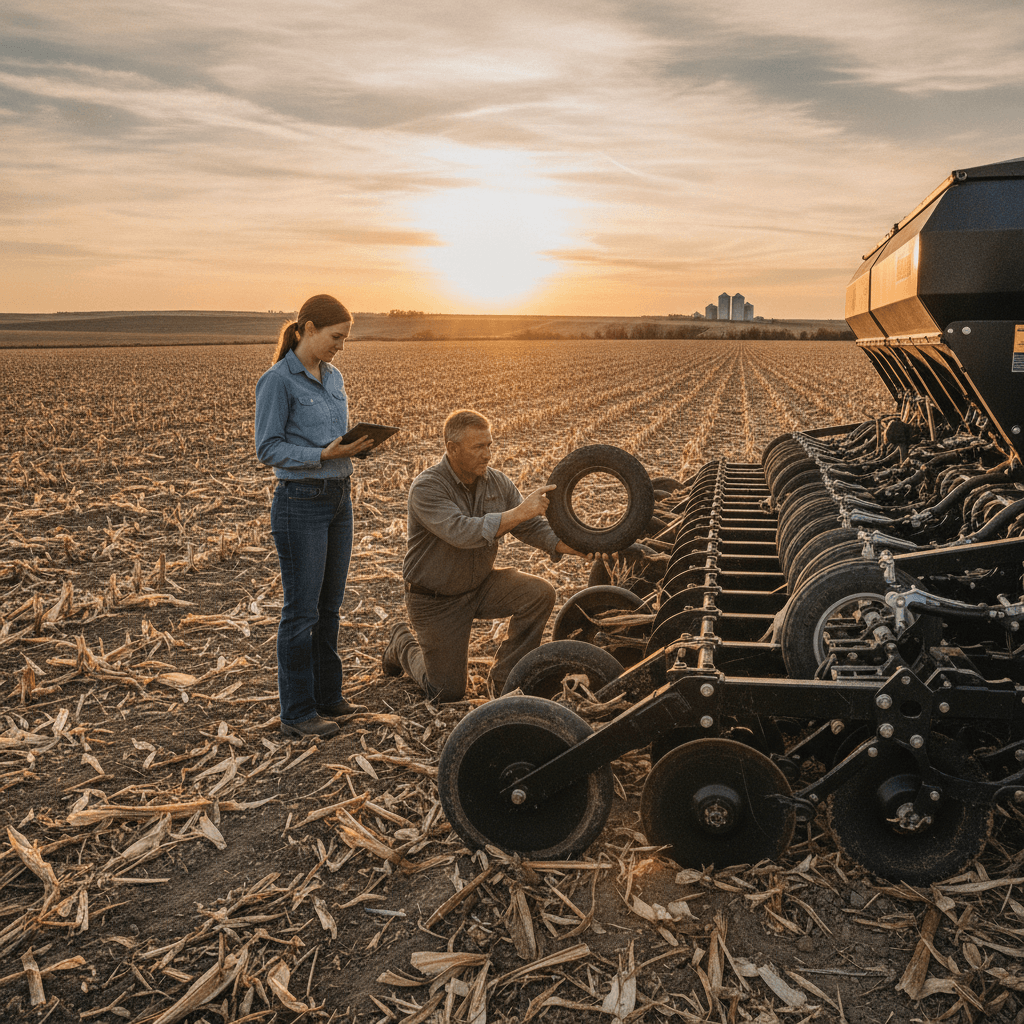
How Do You Know When to Replace vs. Repair Gauge Wheels on a No-Till Drill Near Brookings?
If you’re running a no-till drill near Brookings and your gauge wheels look rough but haven’t completely fallen apart, the question isn’t whether they’ll eventually need replacing — it’s whether they need replacing right now, before you put another crop in the ground. That distinction matters a lot when you’ve got a 10- to 14-day planting window and a full drill to prep. Here’s a straightforward way to make the call, and what it actually costs you when you guess wrong.
- The Real Cost of Running Worn Gauge Wheels Too Long
- What to Actually Look For: A Field Inspection Checklist
- Repair: When It's Actually Worth It — and When It Isn't
- What Competitors Don't Tell You About Gauge Wheel Wear in No-Till
- Timing the Replacement: Don't Wait Until March
- Frequently Asked Questions
- Ready to Upgrade Before Next Planting Season?
The Real Cost of Running Worn Gauge Wheels Too Long
Gauge wheels on a no-till drill do two things: they control seeding depth and they hold the furrow open while the seed goes in. When the tire is worn unevenly, cracked at the bead, or so clogged with residue it can’t roll cleanly, neither of those functions works right. You end up with inconsistent seed depth across the row — some seeds planted at 1.5 inches, others at 2.5 or deeper — and that variability shows up in uneven emergence and lower final stands.
In no-till conditions, especially in the heavier soils you find from Brookings west toward the Missouri River, a worn gauge wheel that can’t shed residue or mud is a serious problem. The wheel stops rolling and starts smearing, which compacts the furrow wall and makes it harder for roots to establish. You might not see it at planting, but you’ll see it in July when the stressed plants start showing up in your stand maps.
What to Actually Look For: A Field Inspection Checklist
Before deciding to repair or replace, get the drill up on stands and go through each row unit. You’re looking for these specific things:
- Tire bead cracking or separation: If the rubber is separating from the rim at the bead, that wheel is done. You can’t repair a cracked bead — it’ll lose its shape under load and your depth control is gone.
- Flat spots or out-of-round wear: Set a straightedge across the tire face. Flat spots from dragging or locked-up hubs mean the wheel isn’t rolling true, and your depth will vary row to row.
- Hub bearing play: Grab the wheel and rock it. Any noticeable slop means the bearing is worn. A worn bearing lets the wheel wobble under load, which again kills depth consistency.
- Spoke or rim damage: Bent spokes on cast or stamped wheels can change how the wheel tracks in the furrow. Look for cracks in the rim casting near the spoke roots — those tend to propagate under the stress of no-till conditions.
- Mud and residue packing: If the spaces between spokes are packed solid and the wheel can’t shed material, that’s a design problem more than a wear problem. Solid-spoke or tight-spoke designs struggle badly in the wet springs you get across eastern South Dakota and into Minnesota and Iowa. This is worth noting when you decide what to replace with.
Repair: When It’s Actually Worth It — and When It Isn’t
Bearing replacement is a legitimate repair. If the tire and rim are in good shape but the hub is sloppy, swapping the bearing is cheap and extends the life of a serviceable wheel. Same goes for a tire that’s lost air pressure due to a slow bead leak — sometimes a bead sealer gets you another season if the rubber itself is still solid.
Everything else is usually a false economy. Wrapping worn tire beads with tape, shimming loose hubs, or running wheels with visible flat spots just shifts the problem into the field where it costs you more. If you’re looking at a tire that’s visibly flattened on one side, or a cast wheel with cracked spokes, put it in the scrap pile. The yield loss from poor depth control across even 100 acres adds up to far more than the cost of new wheels.
A practical rule: if more than two row units on a drill need anything beyond a bearing swap, it’s usually more cost-effective to replace all the gauge wheels at once so you’re not chasing problems row by row over the next two or three seasons.
What Competitors Don’t Tell You About Gauge Wheel Wear in No-Till
Most gauge wheel suppliers — and most of the major equipment accessory companies — focus their content almost entirely on planters. No-till drill gauge wheel wear gets a fraction of the attention, even though the operating conditions are often harder. No-till drills run through heavy surface residue, tougher soils, and frequently wetter conditions than a conventional planter does. The wear patterns are different, and the plugging risk is higher.
Open-spoke gauge wheel designs shed mud and residue significantly better than solid or close-spoked alternatives. Jung Enterprise’s Curved Spoked Gauge Wheels use an open-spoke geometry specifically to keep material moving through rather than packing in. In field testing, that design held up to only 1/16 inch of wear over 13,000 planted acres across three seasons — that’s the kind of longevity that changes your replacement math considerably.
Timing the Replacement: Don’t Wait Until March
If you’re farming near Brookings or anywhere across eastern South Dakota, you already know that late-winter equipment decisions are made under pressure. Parts availability tightens up in February and March as dealers from Sioux Falls up to the Minnesota border all start prepping for the same planting window. If you do your post-harvest inspection in October or November and identify wheels that need replacing, you have time to order, compare options, and install without rushing.
Waiting until the ground is ready to plant to discover you need new gauge wheels means downtime during the window you can least afford to lose. The weather in the Northern Plains doesn’t give you many makeup days.
It’s also worth considering the full row unit while you’re in there. If your gauge wheels are worn, check whether the tire lip itself shows damage from repeated rim contact. Steel rings protect the tire bead from that wear and double as a built-in scraper — one part that handles two problems without adding another piece to maintain.
Frequently Asked Questions
How many acres should a no-till drill gauge wheel last before replacement?
It depends heavily on soil type and operating conditions, but a quality gauge wheel in typical no-till conditions should last multiple seasons. Jung Enterprise’s curved spoked gauge wheels showed only 1/16 inch of wear after 13,000 acres — a strong benchmark for comparison when you’re evaluating options.
Can I replace gauge wheels on a no-till drill myself, or do I need a dealer?
Most gauge wheel replacements are straightforward bolt-on work you can handle in the shop. The more important question is whether you’re replacing with the right wheel — one that fits your drill’s hub pattern and row unit geometry. Check compatibility before ordering, and reach out to the manufacturer if you’re unsure.
Do open-spoke gauge wheels work better than solid wheels in heavy South Dakota soils?
Yes, in most cases. Open-spoke designs shed mud and residue rather than packing it in, which keeps the wheel rolling cleanly and maintains consistent furrow depth. Solid or narrow-spoked wheels tend to clog in wet clay soils, which is exactly the condition you’re dealing with in a wet spring across eastern South Dakota and into Iowa and Minnesota.
What’s the difference between gauge wheel wear on a planter versus a no-till drill?
No-till drills typically run through heavier residue and harder soil conditions than row-crop planters, which accelerates wear — especially on the tire bead and rim contact area. The load per row unit is also often higher. That’s why it’s worth paying attention to bead integrity and rim condition specifically when inspecting drill gauge wheels, not just the tire tread.
How do I know if my gauge wheel is causing inconsistent planting depth?
Pull emergence photos or use a planting depth probe after seeding a test strip. If you’re seeing more than 1/4 inch of depth variation row to row, and your down-force settings haven’t changed, worn or out-of-round gauge wheels are a likely culprit. Check for flat spots and bearing play at your next maintenance inspection.
Ready to Upgrade Before Next Planting Season?
Jung Enterprise is based in Ipswich and builds gauge wheels, steel rings, and wheel retainers specifically for the conditions farmers deal with across South Dakota, North Dakota, Minnesota, Iowa, and Nebraska. Everything is American-made, patented, and field-tested — not imported hardware sold on spec sheets. If you’re evaluating gauge wheel options for your no-till drill ahead of next season, reach out to us directly and we’ll help you figure out what fits your drill and your operation.