
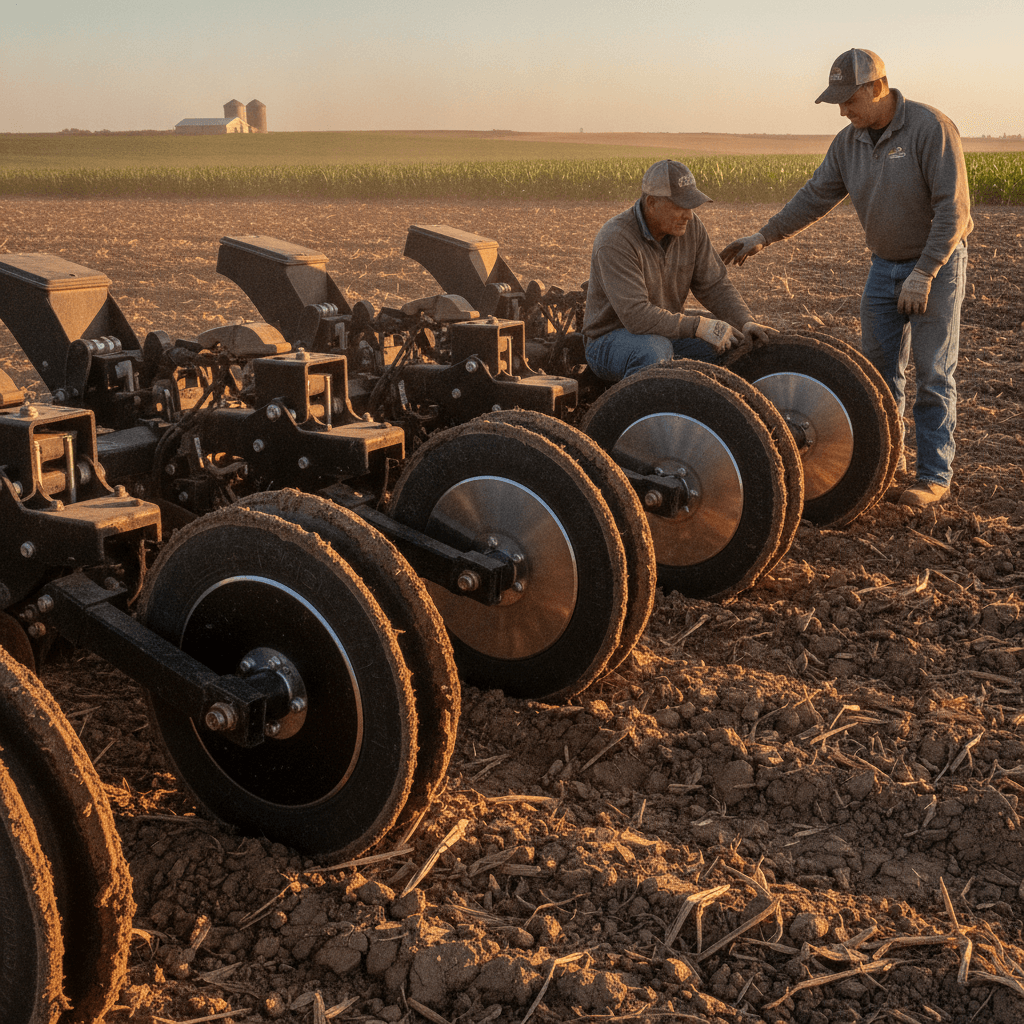
Why Do Planter Tire Lips Wear Out So Fast Near Ipswich — And What You Can Do About It Before Next Season
If you’re farming anywhere near Ipswich and you’ve been going through gauge wheel tires faster than you think you should, the tire lip is almost certainly where the damage starts. That thin rubber edge that rides against the opener disk — the lip — takes constant abrasion from soil, grit, and the disk itself. In normal conditions it wears slowly. In South Dakota clay and gumbo, it wears fast. And when it’s gone, your planting depth control goes with it.
This is one of those maintenance problems that sneaks up on operators. You’re not going to see a blown tire or a cracked spoke. The tire looks fine from ten feet away. But up close, that lip is ground down, the tire is no longer pressing consistently against the disk, and your seeds are going in at inconsistent depths. By the time you notice irregular emergence in the field, you’ve already planted several hundred acres with compromised depth control.
What’s Actually Causing Tire Lip Wear
The gauge wheel tire lip wears from two directions at once. First, the obvious one: soil abrasion. Every pass through the field, that lip is dragging through grit, sand, crop residue, and whatever hardpan or crust the opener is cutting through. Second — and this is the one most farmers overlook — the constant contact with the opener disk itself grinds the lip down over time. The disk is steel. The tire is rubber. Rubber loses that fight eventually.
In wet spring conditions, the problem gets worse faster. Clay and gumbo soils — common across the Northern Plains from Ipswich down to Huron and east toward Aberdeen — don’t just wear the lip, they pack into the gap between the tire and the disk. That packed mud creates friction and pressure the tire wasn’t designed to handle continuously. The lip starts to roll, crack, or abrade unevenly. Once wear becomes uneven, the disk-to-tire contact becomes inconsistent, and you’ve lost the tight tolerance that makes the gauge wheel do its job.
Why This Gap Gets Ignored by Most Equipment Manufacturers
Here’s what’s worth noting: if you go looking at content from the major planter equipment companies, you’ll find plenty of information about gauge wheel design, bearing life, and mud-shedding performance. What you won’t find much of is direct discussion of tire lip protection as a standalone problem with a dedicated solution. The assumption seems to be that you’ll just replace the whole tire when it wears out — or the whole gauge wheel assembly.
That replacement model works fine if you’re the company selling the replacement parts. It doesn’t work as well if you’re the farmer writing the check. A full gauge wheel assembly costs real money, and if you’re running a 16- or 24-row planter, you’re multiplying that cost across a lot of row units. Replacing them every few seasons because nobody addressed the tire lip wear earlier is an expensive cycle to be stuck in.
That’s the gap Jung Enterprise’s patented steel ring was built to fill.
How a Steel Ring Stops Tire Lip Wear Before It Starts
The steel ring mounts directly to the gauge wheel tire — six screws, straightforward installation — and sits at the tire lip. It does two things simultaneously. First, it protects the lip from the abrasion that would otherwise eat through it. The steel takes the wear instead of the rubber. Second, it acts as a built-in scraper, knocking mud and debris out of the gap between the tire and the disk as the wheel rotates.
That second function matters more than it sounds. On a wet spring day in clay ground, a scraper that’s integrated directly into the tire means you’re not relying on a separate add-on that can misalign, loosen, or get knocked off by residue. The scraping happens continuously, right at the contact point, every rotation.
Field results back this up. Jung’s steel ring has been tested across 13,000 planted acres over three years and showed only 1/16 inch of wear over that period. That’s the kind of durability number that actually means something when you’re trying to decide whether a part is worth the investment — not a marketing claim, but a measured result from real field use.
What That Means for Your Cost Per Season
If a gauge wheel tire is lasting you one to two seasons in your current conditions before the lip wear degrades performance enough that you’re replacing it, adding a steel ring changes that equation. You’re protecting the tire rather than just running it until it fails. Fewer replacements, less downtime during planting, and fewer row units operating at degraded depth control while you wait for parts to arrive.
For custom planters running back-to-back jobs in the spring window, that tradeoff is especially direct. Every hour of downtime during a narrow planting window near Ipswich or across the surrounding area is an hour you can’t get back. Parts that extend intervals between replacements pay for themselves in reduced scramble time alone.
When to Address This — Before Spring, Not During It
Post-harvest and late winter are the right times to evaluate tire lip condition and decide whether steel rings make sense for your operation. Pull a few gauge wheels off your planter or air seeder and actually look at the lip edge. If it’s visibly rolled, cracked, or thinner than the tire sidewall, you’re already past the point where prevention would have helped. For next season, adding steel rings now means you go into spring with the protection already in place rather than trying to solve the problem mid-planting.
If you’re running a no-till or strip-till setup, the urgency is higher. No-till planters operate in heavier residue conditions and typically deal with more aggressive disk contact than conventional systems. The wear cycle on tire lips tends to run faster in those applications.
Frequently Asked Questions
Do steel rings work on all gauge wheel sizes?
Jung Enterprise’s steel rings are designed to fit planters, air seeders, and no-till drills across multiple OEM brands and gauge wheel sizes. Contact Jung directly to confirm fitment for your specific equipment before ordering.
Do I need a separate scraper if I’m using a steel ring?
No. The steel ring functions as a built-in scraper at the tire lip, which eliminates the need for a separate scraper component. That’s one fewer part to install, maintain, or replace.
How long does installation take per row unit?
The steel ring mounts with six screws directly to the gauge wheel tire. Most operators can work through a multi-row planter in a reasonable shop session without specialized tools or equipment.
Is tire lip wear worse in South Dakota clay soils than in sandier ground?
Generally, yes. Clay and gumbo soils — common across the Northern Plains region including areas around Ipswich, Aberdeen, and Huron — are harder on tire lips than lighter soils. They pack tighter, create more friction at the disk contact point, and hold moisture that accelerates rubber degradation.
Can I add steel rings to a planter that’s already showing some tire lip wear?
If the lip isn’t completely gone, steel rings can still slow further wear and extend usable tire life. If the tire is already at the point where depth control is compromised, replacement first — then steel rings on the new tires — is the better sequence.
Talk to Jung Enterprise Before Your Next Planting Season
Jung Enterprise is based in Ipswich and builds patented, American-made parts for farmers who need equipment that holds up through the whole planting season — not just the first few hundred acres. If tire lip wear has been eating into your parts budget or your uptime, the steel ring is worth a closer look.
Take a look at the full product lineup or reach out directly to talk through your specific planter setup and what fitment looks like for your operation. You can contact the team at Jung Enterprise through the contact page — or call (605) 281-0497.